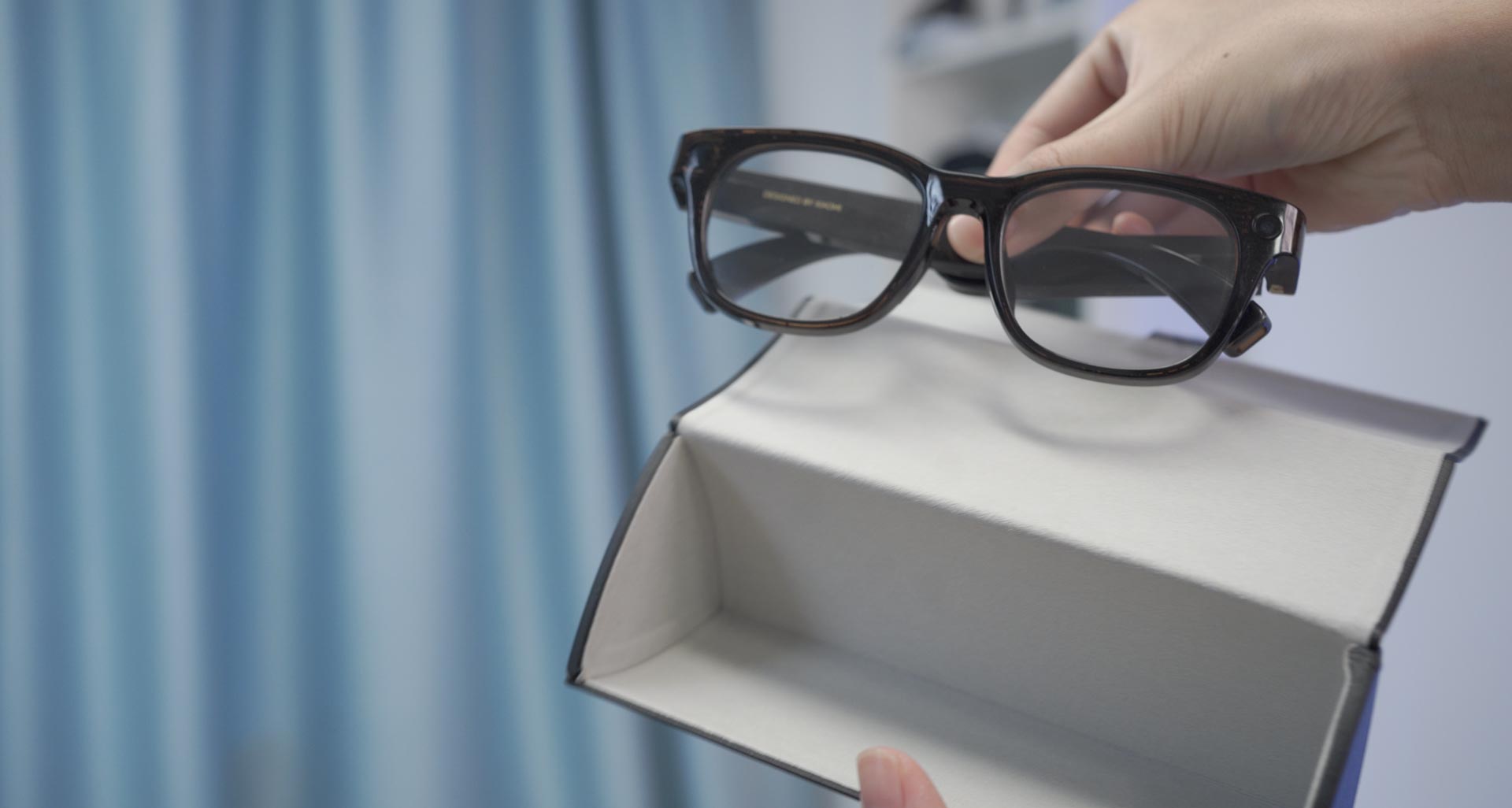
Xiaomi AI Glasses hands-on: a promising first-gen product
A few weeks ago, Chinese tech giant Xiaomi released to the public its AI smartglasses. The Xiaomi AI Smartglasses are currently available online in China, but many people in the XR communities in the West started wondering if they are any good, and especially how they compare with the more famous Ray-Ban Meta. Well, today we are here to answer all of these questions.
But it won’t be me doing that. To write this article, I asked for the help of DannieVR, a Chinese XR-focused content creator. In China, she’s very appreciated for her work as a video creator and also as a community member. She’s not well-known here in the West because she usually works on content in Chinese language: she has a Youtube channel, but most of the content is in Mandarin, too. Anyway, show her some love by subscribing to it!
Dannie had the opportunity to thoroughly test the Xiaomi AI Glasses, and she’s preparing a video review about them. But while we wait for her video, she has been so kind to write, as a preview, the following article for all of us! So keep reading to discover how good these glasses are from Dannie’s point of view…
Xiaomi AI Glasses
When Xiaomi releases a product, it’s rarely just about hardware. It’s about ecosystem, strategy, and (let’s be honest) aggressive pricing. So when I saw the ¥1999 (circa 280 USD) price tag on the new Xiaomi AI Smart Glasses, I had one reaction:
Lei! (The president of Xiaomi) Didn’t you say you were going to drive the price down?
Let’s get into it, because these glasses are interesting. Not because they’re revolutionary, but because of what they represent.
First, the context: what is Xiaomi really doing?
Xiaomi isn’t just a smartphone brand. It’s one of the largest tech giants in China, with a product portfolio that spans smartphones, smart home devices, wearables, laptops, TVs, and now even electric vehicles. (Yes, they recently launched the YU7, an electric car aimed squarely at Tesla’s Model Y.)
What makes Xiaomi special is its ecosystem play. Everything connects. If you live inside the Xiaomi universe, these glasses are not just smart, they’re a natural extension of your daily life.
Design and comfort: lightweight, stylish, wearable

These glasses weigh 40g (without lenses) and come in three colorways:
- Black
- Tortoiseshell Brown
- Parrot Green (surprisingly wearable)

They feature a D-style frame, and electrochromic lens options:
- Monochrome version: adjusts from dark black to light gray in 4 steps
- Color-shifting version: cycles through violet, blue, pink, and gray
The standard model supports official prescription lens customization, which is great — but fit can vary, so Xiaomi recommends trying them on in-store.

Design and fit: surprisingly comfortable for Asian faces
Let’s talk about the look, and more importantly, the fit. The Xiaomi AI Smart Glasses actually fit Asian faces really well.
One of the common complaints I’ve heard about the Meta Ray-Ban smartglasses is that they tend to slide down, especially for people with lower nose bridges, which is quite common in East Asian facial structures. Xiaomi, being a Chinese brand, clearly took this into account. These stay in place better, and I didn’t have to constantly push them back up my nose.

As for looks? Personally, I love the oversized frame, I’m someone who’s always gone for big glasses. But I get it… it’s subjective. Some of my friends think the plastic build looks a bit cheap, but I do think the arms (temples) of the glasses look bulky and thick.
My personal rating? I’d give it a 7 out of 10. It’s functional, fits well, and stylish enough for everyday use, especially if you like bigger frames.
Powered by Snapdragon AR1 Gen 1 + Low-power Platform

Under the hood, Xiaomi uses Qualcomm’s Snapdragon AR1 Gen 1 platform, paired with a low-power coprocessor to handle AI, voice, and media tasks. The memory is 4GB RAM + 32GB ROM.
Performance is snappy, and battery life is solid:
- 8.6 hours of typical mixed-use time (the battery life is slightly longer than Meta Ray-Ban, based on what I have tested)
- Up to 1 hour video recording time (each video clip can be up to 10 minutes long)
- Charges via USB-C in ~45 minutes
Audio: Just okay (don’t expect bass)

Let’s be honest: audio is not this product’s strong suit.
Yes, it features two open-ear directional speakers, and for podcasts or casual videos, they’re fine. But compared to the Meta Ray-Ban smartglasses, the bass is flat and the overall sound lacks richness. If Meta Ray-Bans sound like a pair of lightweight headphones, Xiaomi’s glasses sound like a decent phone speaker pointed at your ear.
Bluetooth 5.4 with AAC helps with connection stability, but this is definitely a case of function over fidelity.
Camera: Decent photos, so-so video, not-so-smooth stabilization
The glasses come with a 12MP camera (4032×3024 photos) and can record up to 2K 30fps videos (2048×1080). You activate it via a physical button: short press for photos, long press for video (up to 10 minutes per clip).
In good lighting, photos are surprisingly decent — Xiaomi’s image tuning delivers slightly saturated but pleasing colors, especially when viewed on a phone.
Videos are more of a mixed bag.


Xiaomi includes software-based stabilization, which helps with walking or light movement — but compared to Meta’s glasses, the result feels a bit artificial. Motion smoothing is more “corrected” than “natural,” and the effect is noticeable when filming dynamic scenes.
Low-light video is… rough. Noise creeps in fast, and motion blur increases. This isn’t a GoPro, or even a Insta360 Go 2, replacement.
AI Assistant: Talkative, sometimes clever, occasionally clueless
One of the headline features of Xiaomi’s smartglasses is the built-in voice assistant, Xiao Ai (小爱同学). You can wake it up by saying its name, and it supports continuous dialogue, meaning you don’t have to repeat “Hey Xiao Ai” every time, which is genuinely nice. You can use it to:
- Start video recordings with your voice
- Translate simple sentences
- Identify objects or estimate food calories
- Ask general questions (visual Q&A)
The calorie feature is neat in theory, but questionable in execution. More importantly, you can’t call the assistant while recording video, which kills any “hands-free workflow” dream.
Plus, here’s the thing: the AI feels kind of… naïve.
Case in point: I stared straight at a Tesla Model Y and asked, “What car is this?”
Sometimes, it correctly answered “Tesla Model Y.”
But other times, it confidently said: “This is a Xiaomi SU7.”
Uh… nice try?
There are moments where it actually works quite well. For example, I held up a bottle of Jägermeister with English text, and asked what it was. It not only recognized the label correctly but also explained that it’s often used in cocktails. That was helpful.

Still, for me, these “AI moments” are rare. Most of the time, I find myself not using Xiao Ai at all.
The most practical AI use case might be menu translation when traveling. Or maybe asking for weather updates and basic Wikipedia-style facts. But anything beyond that? I usually just reach for my phone and open ChatGPT.
So yes, the glasses have AI. It’s there. It talks. But if you’re expecting a Jarvis-level assistant that changes how you interact with the world, you’ll be disappointed… at least for now.
That said, there’s one surprise:
Smart Home Control: This is where it gets interesting
If you have a Mi Home-powered smart home, these glasses become a voice remote on your face.
- “Xiao Ai, turn on the air conditioner.”
- “Turn off the lights.”
- “Start the robot vacuum.”
You don’t need a speaker nearby. The glasses become your mobile control center — and it actually works.
Ecosystem bonus: POV calls with Xiaomi phones
If you’re using a recent Xiaomi flagship, here’s a neat trick:
Whenever you’re in a video call (say, on WeChat or another supported app), your phone can detect the glasses as an external camera — letting you switch to your first-person view on the fly. Want to show someone exactly what you’re seeing in real-time? Just switch to the glasses cam: now that’s a true “point of view” conversation.
It’s a small feature, but one that’s only possible because of Xiaomi’s tight hardware-software integration. And honestly, it’s pretty awesome. That’s the real power of Xiaomi’s ecosystem.

Connectivity & Controls
- Wi-Fi 6 (5GHz)
- Bluetooth 5.4 with AAC
- Type-C charging
- IP54 dust/water resistance
- Temperature range: 5°C ~ 35°C
- Companion app works on Android 10+ / iOS 15+
Verdict: Smart if you’re in the Xiaomi ecosystem; otherwise, wait
So here’s the honest take:
If we break down the value:
- Audio: ¥300
- Camera + software stabilization: ¥1000
- Smart home control: ¥300
The total is: ~¥1600
But the actual price is ¥1999 (circa 280 USD). And at that level, you start asking questions like: “Should I just get Meta Ray-Ban glasses instead?”. For ¥2500, Meta’s glasses offer better build, better audio, smoother stabilization, and a stronger AI backend. (Although Meta AI is Banned in China). No smart home features, though.
If Xiaomi priced these glasses at ¥999 (circa 140 USD), it would be an instant recommendation. But right now, this is a “yes, but…” product:
- Yes, if you’re already a Xiaomi phone + smart home user
- Yes, if you need a casual POV camera with music playback
- Yes, if you love playing with emerging tech
- But… not if you expect polished AI or media performance at this price point
Final thoughts
The Xiaomi AI Smart Glasses aren’t here to wow you with AI magic. They’re here to slide quietly into your lifestyle — especially if that lifestyle is powered by Xiaomi.
As a Gen 1 product, it’s not perfect. But it’s not trying to be. It’s trying to be useful. Quietly smart. And part of a much bigger story. And if Xiaomi can keep this up — refining audio, boosting AI, polishing the camera — then Gen 2 might be the one that finally clicks.
Disclaimer: this blog contains advertisement and affiliate links to sustain itself. If you click on an affiliate link, I'll be very happy because I'll earn a small commission on your purchase. You can find my boring full disclosure here.