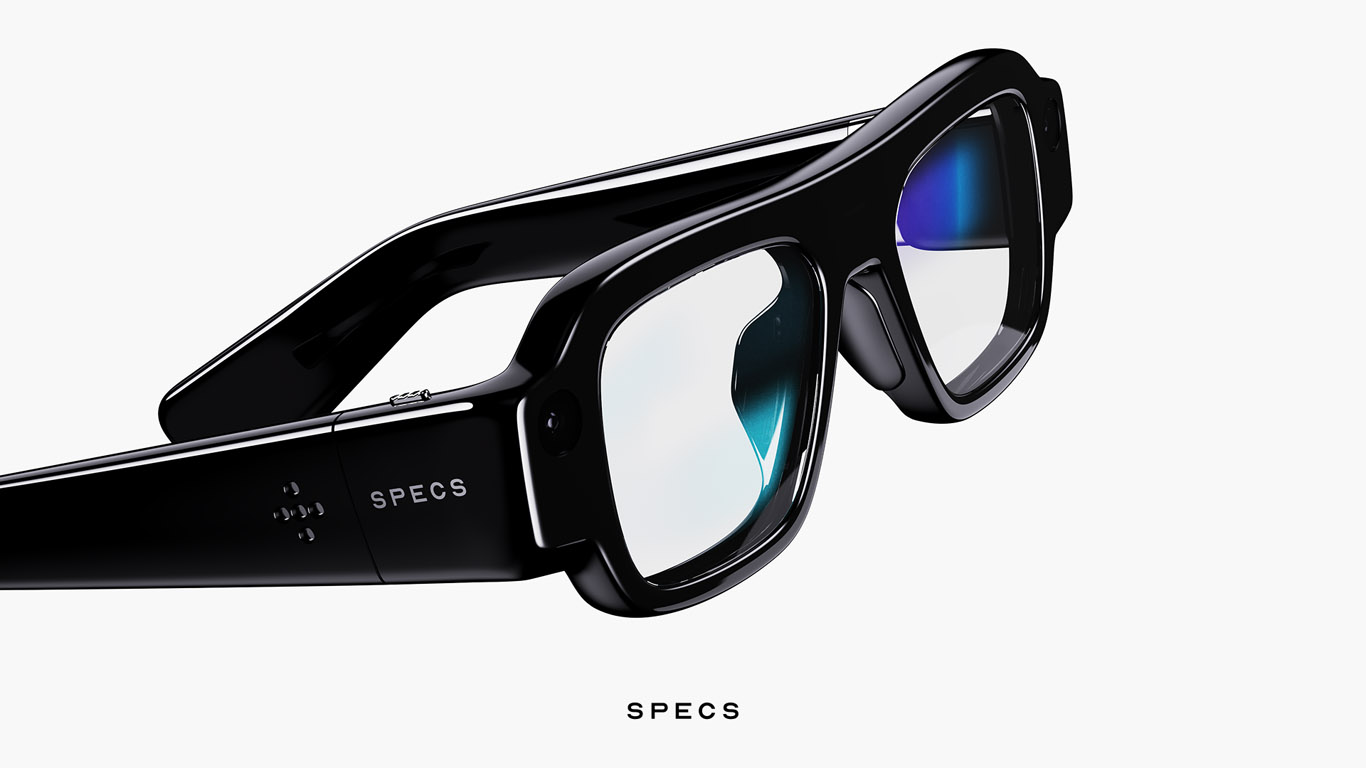
After having unveiled its Specs glasses at AWE, today Snap has officially launched its glasses. And it has done that by unveiling new details about them, with a strong focus on the use cases of the device. Let me tell you what the company has announced today, with also my personal commentary about whether this is going to change the common perception about the utility of the glasses.
The trailer with which Snap has shown all the use cases of the Specs glasses
New case with cellular data
I’ll start this article with the news I’ve found the most interesting: Snap is launching a new dedicated case for the Specs glasses that not only charges the device, but can also provide cellular connectivity.
Specs inside their new charging case (Image by Snap)
Specs, like all the other AR/VR glasses at the moment, just connect to the internet via Wi-Fi. They don’t have their own Internet connection. With the SPECS Charging Case with Cellular, Snap changes the game. The case where you hold the glasses can also provide the glasses with their own dedicated network. This means that you have to bring the case always with you, but you would have to do that anyway because the battery of Specs can’t last all day. So instead of bringing just a charging case, you bring a case that can charge the device 4 times and also gives it Internet. This is definitely interesting
The price of this accessory is around $200 when bundled with the glasses. Let me copy-paste the press release to give you additional details about the logistics:
In the United States, Snap is partnering with Verizon to offer custom data plans, flexible financing, digital setup and hands-on experiences at select Verizon stores. The SPECS Connected Case bundle will be available for $2,395. Verizon will offer eligible customers financing options, including a 36-month payment plan. Connected Wearable data plans are available from $10/month for Verizon customers and from $20/month for non-Verizon customers. Snap is also partnering with global carriers, including Orange in France and EE in the UK. Data plans will be available through the respective carrier partners, with pricing details to come.
This is something that is rather new for the industry, and I personally think this is the biggest innovation announced today. Your glasses don’t have to use the phone connection anymore, but can have their own. Of course, the end game should be putting the SIM card inside the glasses, and hopefully we’ll get there.
Enterprise Support
Front view of the glasses (Image by Snap)
When the $2,200 price of the Specs was unveiled, we all immediately thought that these glasses can’t have a mainstream appeal. But we also thought that that price could still get the interest of the enterprise world: all-in-one AR glasses may be very interesting for remote assistance, for instance. HoloLens and Magic Leap proved there is a market for AR in B2B. That’s why when I met people from Snap at AWE, I advised all of them to try the enterprise route, because there could be a market there. Well, the good news is that they listened.
Snap announced to have partnered with Salesforce, AWS, HoloLight, Trifork, and NVIDIA to create various enterprise-oriented solutions on its glasses. Most of the solutions offered are the typical ones we have already seen with the other glasses: we are mostly talking about having remote assistance, or getting information and visualizing documents in AR while being hands-free to operate a machine. The partnership with NVIDIA is about making the XR AI framework compatible with Specs, so that employees can have glasses that are connected to an AI assistant that is installed on a local workstation so that the data of the company stays in the company. Snap also announced that it is building the ecosystem to make enterprise use possible, like for instance the compatibility with MDMs (Mobile Device Management systems).
HoloLight is meant to improve the productivity of enterprise workers (Image by Snap)
There is no mind-blowing use case here: we have already seen these solutions one million times. But what is interesting is that Snap actually acknowledged that its device may have an enterprise appeal and has gone for that route. I think it’s a smart idea. The only problem I see is that I’m not fully sure that enterprises are willing to work with the software of a social media company like Snap. But hey, it worked with Facebook…
Try before you buy
Exploded view of the waveguide of Specs (Image by Snap)
It’s hard to explain AR glasses just with videos and photos. That’s why Snap had the right idea to open up an experience center where people can try SPECS glasses and also chat with people from the team. Beginning October 1, the SPECS First Look will be available at Westfield Century City in Los Angeles.
Unfortunately, it is only one location for now, but it’s, in my opinion, a step in the right direction. We need more demo centers for XR technologies. People will never get why they are useful if they don’t try them. Kudos to Snap for opening this center. I hope there will be more.
Specs Intelligence
The trailer for SPECS Intelligence
Snap has announced Specs Intelligence, which is basically an AI assistant that guides you during your whole day. Specs Intelligence is available on all your devices, from your Mac to your iOS phone, up to your SPECS glasses (it’s evident that Evan is a fan of Steve Jobs… there is no trace of Android or Windows for now).
When you set up the assistant, you tell it your goals. Then you let it connect to your apps, like your calendar. So the AI knows everything about you, and when it is running on your glasses, it is also aware of your spatial context. Specs Intelligence can use all your data to support you in every moment of your life: it gives you reminders before appointments; it answers your questions; it helps you in booking flights; it can provide you with digests about your days; and so on. Since it also runs on Mac (where you probably work) and iOS (where you interact with people), it really can follow you during all your activities.
Again, this is not anything particularly new. Meta itself released last week a new Meta AI that becomes your personal assistant. I guess that since we are in the hype period for AI, it is something that every company must provide as a service. Honestly, I’ve still to see someone who has his/her day completely organized by AI, so count me a bit skeptical about the actual utility of these services. But for sure, having a few reminders and an AI that answers your questions still provides some value.
Specs Intelligence running on all your devices (Image by Snap)
The question is always how all the data that AI is collecting about you is managed. I appreciate that Snap took the time to make a clear statement about the management of the data and the care towards the privacy of the user:
You choose what you connect and what information SPECS Intelligence can use. SPECS Intelligence is designed so Snap personnel cannot view or access the personal content you use with the service. Personal content from connected accounts will not be used to train or fine-tune Snap’s AI models, or to serve personalized ads. SPECS Intelligence uses on-device processing and secure cloud infrastructure, with security protections wherever data is processed.
Specs Intelligence can already be previewed today through the SPECS app for iOS, even by people without the glasses.
I have mixed feelings about this feature. As I’ve said, I think it was a necessary feature to release, because everyone now is into personal AI assistants. Plus, its assistant seems well made, and the idea to make it multi-platform so that it can follow you everywhere is definitely a smart one. I totally agree with Snap that the future is having AI assist us in every moment of our lives through glasses. But in my vision, most of the data stays local: these glasses could basically collect all the info about my personal and professional life and upload it to some Snap servers. And while Snap reassures us that our data is safe today, nothing prevents it from changing the terms and conditions later on, for instance enabling personalized ads. It wouldn’t be the first time a big tech company does so. That’s why I remain always a bit skeptical about the systems that can collect so much data about me.
New content for the glasses
Snap has also announced a lot of new content and use cases for the glasses.
The visionaries’ premium content
Let’s start from the “visionaries”: Snap partnered with a few visionaries like the singer Imogen Heap to create Lenses (i.e., applications for the Snap ecosystem) that could fulfill their vision. But seeing what they have produced, I am a bit puzzled. Jimmy Butler, for instance, contributed to making a multiplayer domino game. Which I could have coded in a week in Unity.
One week of work in Unity, maybe even less (Image by Snap)
Another app is about meditation, and another about taking notes from a book. I honestly think these “visionaries” need some prescription lenses for their vision. These are very basic apps, with ideas that are not mind-blowing at all. If Snap gave me the same money it has given to them, I could have crafted much more original solutions. This “visionary” thing has proven to be more a marketing stunt than a real utility. I am quite frustrated by this.
Another “visionary” app (Image by Snap)
The only “visionary” lens with some originality is the virtual instruments created by Imogen Heap, who has also performed during the launch event, freestyling with it. She did a pretty good job.
Other lenses
Snap announced some nice pieces of content for its glasses. Let me again copy-paste from the press release:
Together with the NBA and WNBA, we’re building interactive basketball experiences that help fans practice in a whole new way. Using a real ball and hoop, SPECS can layer visual guidance, drills, and progress cues directly onto the world around you, making it easier to work on your game.
This basketball thing is pretty cool (Video by Snap)
Coming next year, ALO Wellness Club will bring movement, recovery, and mindfulness into every part of the day through guided experiences designed to extend the practice beyond the mat, whether you’re walking through the park, stretching at home, or taking a moment to reset between meetings.
You can also sharpen your footwork with the Soccer Skills Lens. It puts you on a virtual training course with dribbling drills that get progressively more challenging as you advance. Or work on your golf swing with a Lens that helps improve your swing mechanics or putting stroke. Developed with guidance from PGA Professionals, SPECS can analyze your golf movements and provide personalized advice.
As a soccer fanatic, I would love to play with this one (Video by Snap)
In partnership with HBO Max, we’re bringing the world of Harry Potter to SPECS AR glasses in celebration of the new HBO Original Series, Harry Potter and the Philosopher’s Stone, premiering this Christmas. The new Harry Potter Lens lets you step into milestone moments from the story, from receiving a Hogwarts acceptance letter to choosing a wand to casting iconic spells.
There’s mail for me (Image by Snap)
I guess Harry Potter’s fans would love this (Image by Snap)
This is a piece of the Harry Potter experience that Evan Spiegel played live on stage
For knowledge seekers, SPECS make education more immersive, engaging, and hands-on. AI on SPECS AR glasses can bring contextual information into your view or teach you about your surroundings. Or you can explore an educational Lens to learn about specific subjects. For example, the Apollo 11 Lens brings history and science into your space with an interactive, virtual recreation of the historic moon mission. You can also learn about the night sky with Starmap, which overlays constellations onto your surroundings so you can explore the stars from anywhere, at any time.
Snap Spiegel is now showing the educational Apollo 11 experience on #Specs! It seems a cute experience, maybe a bit limited, though pic.twitter.com/GbpI0fPi8l
For those looking to watch the latest content and TV shows, the SPECS browser enables streaming from YouTube, HBO Max, and more. With a massive virtual display that feels like a 115-inch screen placed about 10 feet away, watching content on SPECS is cinematic and immersive. And SPECS AR glasses feature a Travel Mode which keeps the screen stable even on a moving train or flight.
How YouTube looks on Specs (Image by Snap)
With Spotify, SPECS provide the right soundtrack for whatever you’re doing. Whether you’re looking for music or your next podcast, just tell SPECS what you’re in the mood for, or take a picture, and Spotify can take it from there to recommend a playlist based on the moment.
Spotify on Specs (Image by Snap)
I think the lenses that use the real ball to help you in training for basketball or soccer are pretty neat. This is something I’ve rarely seen on other devices (with the exception of Ballee on Quest). On the technical side, I’m amazed. But from a usability standpoint, would you ever use your glasses costing $2,200 while you play basketball? And how well they perform while you’re sweating? I’m not so sure.
The Harry Potter one is also getting the attention of many fans of the saga. I’m pretty sure it can be a great experience… but I’m not sure people are going to spend $2,200 for this. But people having the glasses for other reasons may appreciate it for real.
As for YouTube and media viewing, understanding the real FOV is the key to understanding how these glasses are truly usable for this use case.
The main menu on Specs (Image by Snap)
Productivity
Side view of the glasses. Are they comfortable enough to wear for a long period of time? (Image by Snap)
Snap is also selling Specs as a productivity device:
SPECS can transform almost any location into an immersive, flexible workspace. SPECS can connect to your computer wirelessly, expanding your workstation beyond the boundaries of a traditional desktop.
Experiences like Whiteboard turn any room into an area for brainstorming and organizing. Whiteboard makes it easy to brainstorm, organize workflows, create diagrams, and more from wherever you are. And SPECS support Bluetooth peripherals like keyboards, making it easy to edit documents on-the-go from anywhere.
It’s definitely a good idea, but two factors are critical to understand if this will actually work. First of all, the long-term comfort: they should be comfortably worn for like 4 hours straight (I doubt it because of the 130+ grams weight and thick frames, but let’s see). The second is the 51° field of view; that should allow you to see a screen that is big enough to let you work. Until a proper hands-on session, I can’t give you an answer about this.
Other use cases
You can also use Specs to support you while you are cooking! (Image by Snap)
Snap SPECS can take photos and videos. You can use them to answer your phone calls. Snap also redesigned Snapchat for SPECS. And you can also listen to music through Spotify or other channels.
Having a call on Specs (Image by Snap)
Snap Spectacles feature translation to up to 60 languages. If I remember well from a test of mine one year ago on the previous glasses, the Specs can place the translation text close to the specific person who is speaking to you, which is pretty cool.
You can’t get lost with maps on specs (Image by Snap)
They also offer navigation options. And thanks to a partnership with Tripadvisor, the glasses can also advise you about restaurants to choose around you. I’m not a big fan of the UX that is visible from the video, but I’ll judge it properly only when I try it:
Tripadvisor lets you see restaurants around you in AR (Video by Snap)
Thanks to a partnership with Shopify, you will be able to browse objects and see them in your home before buying them.
Besides the privacy statement about Specs Intelligence, Snap also provided a privacy statement about the glasses in general. It has clearly been crafted to fight the current fear about “pervert glasses”:
Privacy is deeply important to us and is built into the design of SPECS AR glasses. SPECS do not use facial recognition to identify people. SPECS do not record the world to understand it, and don’t continuously record or save audio, video, or photos. When a wearer takes a photo or records video or audio, a prominent external LED in the center of the frames lights up or flashes to let people nearby see that recording is happening. To make sure the user stays in control, you choose what information and services SPECS can access, and Lenses will ask before accessing sensitive information.
Launch event
The launch event went pretty well, with Even Spiegel being able to deliver his keynote, even doing live demos that didn’t fail!
After the keynote, people are finally going to be able to try the glasses. It will be interesting to read the reviews about them from the AR/VR experts that have been invited.
One thing I noticed, staying at home and tweeting about the announcements, is that the engagement was pretty low. I don’t think there is a lot of hype around these glasses now: probably the high price and the initial lukewarm press reception have a bit hurt the interest in this device. Which is a pity, because it is an innovative product.
Price and release date
The Specs glasses (Image by Snap)
This information was already known. Specs cost $2,195 and can be pre-ordered with a $200 refundable deposit. Shipping is expected to begin later this fall in the United States, United Kingdom, and France. To learn more and pre-order them, visit SPECS.com.
General impressions
I think Snap did a decent job with this launch today, but at the same time, I expected a bit more.
Specs glasses with tinted lenses (Image by Snap)
Let’s start from the positive side: it announced a lot of new apps and showcased a lot of use cases, from translation to AI assistance, not to mention sports training. There is really a lot you can do with these glasses. Plus, the new enterprise route is definitely interesting: Snap understood that the price is too high for the average consumer, so it is wisely trying to go B2B, and hopefully it can find some profitable niche there. I also found the case with cellular data pretty innovative.
But let’s say I expected a bit more. Many use cases are the same we have already seen on other AR glasses or smartglasses. On the enterprise side, too, they are offering apps that are already common in other ecosystems. It is not a bad thing to be on par, but to convince people to spend $2,000+, I think you should go beyond what is common.
I also keep thinking that Snap suffers from the Magic Leap syndrome and doesn’t realize well what the positioning of its device is. Making glasses that cost $2,200, which is a premium price for prosumers, and then creating content about Harry Potter or about playing basketball, which is aimed at kids, makes little sense. The problem is that Snapchat definitely has a young audience, but the cost of this device is for prosumers and enterprise customers. This is going to create some confusion in the marketing of these glasses, as we have already seen in the past with Magic Leap or for the Vive Pro.
Also, all the apps that have been offered look to me like small apps, à la Snapchat lenses. They all look like demos, not like full, complex applications. I guess the fact that these glasses are not compatible with Unity or Unreal starts to show its problems. And it will be even more problematic in the enterprise field, where companies will be looking for complex custom solutions that I’m not fully convinced can be built in Lens Studio.
Watching the event, I had the impression that Specs are a nice device, and that Snap is doing a good job slowly building its ecosystem. This is something that Snap has done very well across the years with Spectacles/Specs: improve the device and improve the number of available apps. But I didn’t feel compelled to buy the glasses, because I haven’t perceived any utility that justifies the price for me. So I am still convinced that these glasses will stay niche. But if Snap keeps building its ecosystem and improving its glasses, maybe the next generation of Specs or the one after that will be much more compelling in terms of price and use cases. I’m crossing my fingers for this to happen.
(Header image by Snap)
Disclaimer: this blog contains advertisement and affiliate links to sustain itself. If you click on an affiliate link, I'll be very happy because I'll earn a small commission on your purchase. You can find my boring full disclosure here.
I’m back in Italy, but I’m still thinking about the beautiful days I had at Meta Connect. And talking about Connect, I want to thank the many people who are still writing me some kind words related to my interview with Boz. It seems that the description of all the emotions I felt resonated with […]
Hello everyone from Mountain View, California! I’m taking the plane quite soon, and the last thing I’ll do here in the US is write this newsletter episode to tell you the most relevant XR news of the week. This has been the week of Meta Connect, so most of this roundup will be about that […]
To provide the best experiences, we use technologies like cookies to store and/or access device information. Consenting to these technologies will allow us to process data such as browsing behavior or unique IDs on this site. Not consenting or withdrawing consent, may adversely affect certain features and functions.
Functional
Always active
The technical storage or access is strictly necessary for the legitimate purpose of enabling the use of a specific service explicitly requested by the subscriber or user, or for the sole purpose of carrying out the transmission of a communication over an electronic communications network.
Preferences
The technical storage or access is necessary for the legitimate purpose of storing preferences that are not requested by the subscriber or user.
Statistics
The technical storage or access that is used exclusively for statistical purposes.The technical storage or access that is used exclusively for anonymous statistical purposes. Without a subpoena, voluntary compliance on the part of your Internet Service Provider, or additional records from a third party, information stored or retrieved for this purpose alone cannot usually be used to identify you.
Marketing
The technical storage or access is required to create user profiles to send advertising, or to track the user on a website or across several websites for similar marketing purposes.