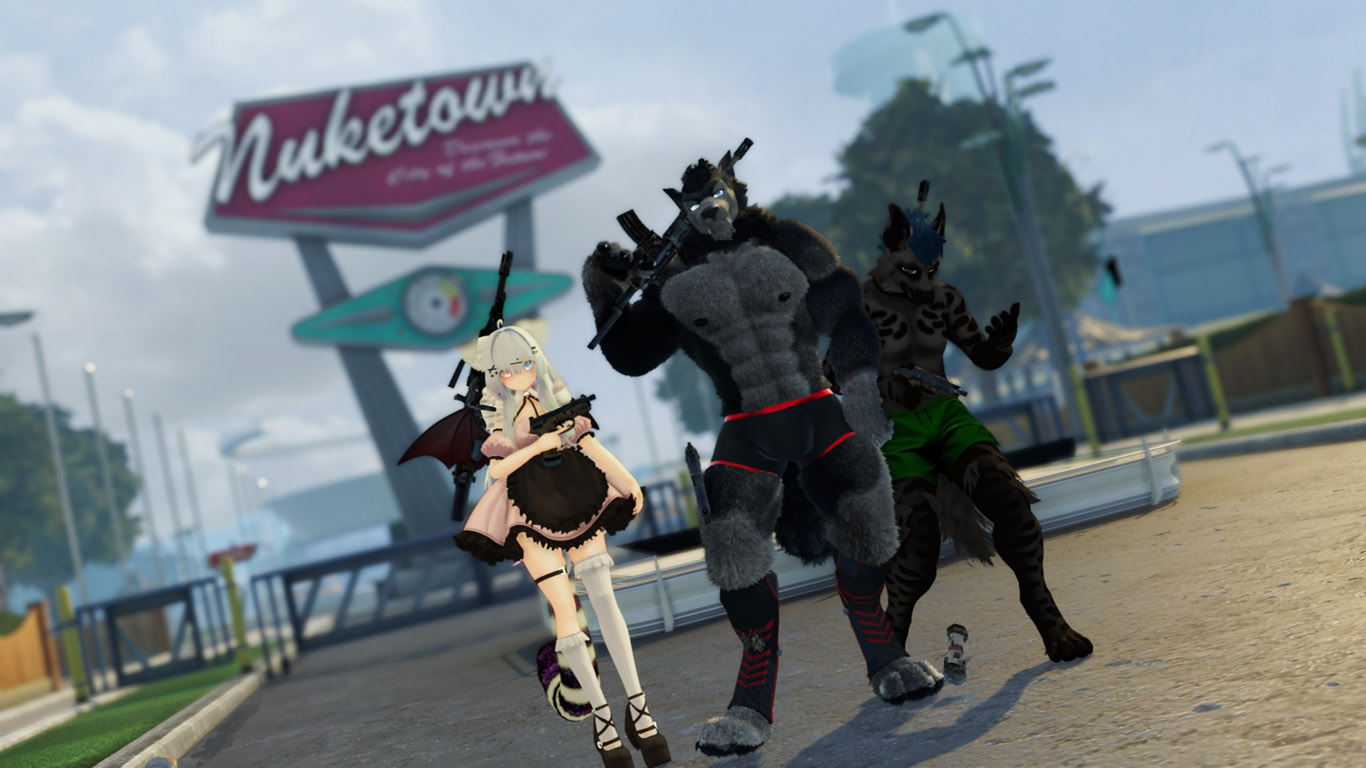
Dreamport is Somnium Space’s metaverse for VR mods
Yesterday at Somnium Connect, Somnium Space did not announce a new headset but showed an interesting new feature for its eponymous social VR platform: Dreamport, a unique take on VR mods that gets many things right.
The walled gardens issue
Let me start this article by telling you one of the first premises that led to the creation of Dreamport: there is no effective way for people to jump with their friends from one VR experience to another.
Standard social VR spaces, like VRChat or Altspace, allow creators to create beautiful worlds using the platform’s creation tools. Users can jump from world to world and enjoy their time, but there is no way they can jump to some application external to the platform. You can’t jump from VRChat to Half-Life: Alyx. And you can’t jump from VRChat to Somnium Space. All the various VR games and social spaces are silos, walled gardens, or whatever other comparison you want to use. They have their own ecosystems, which can even be very large (like in the case of VRChat), but there is no way to jump from one to the other.
This has always been one of the various problems of the so-called “metaverse”: everyone was talking about the metaverse needing interoperability between the different applications, as it happens on the World Wide Web, but no one actually worked on making it happen.

The multitude of VR mods
The second thing that inspired Dreamport was VR Mods. Thanks to the advent of AI, many people are now building VR mods for flat-screen games. You all know this, so I don’t have to explain to you what is happening. Every PC game is becoming a VR game, with enthusiasts converting games every day. I often jokingly say that now there are more VR mods than VR players.
The VR mod scene is amazing, but also very chaotic. There is no common place where to find all mods (even if some VR mod directories are being created); some mods are not easy to install; you don’t exactly know who created a specific mod and how safe it is to run it. So the VR mod scene is doing great, but it has a big share of issues, and this is also preventing less tech-savvy users from playing VR mods.
Dreamport comes to the rescue
Artur Sychov, the CEO of Somnium Space, thought about this situation and came up with the idea of Dreamport, which is a platform that solves both problems. Dreamport is basically a system that allows you to enter all other VR applications thanks to modding from inside Somnium Space. It requires a detailed explanation, so follow me to understand it better.
The integration package
At its basis, Dreamport is an integration package to let external apps work with Somnium Space. This integration package can be applied in two different ways:
- If you are the author of the game, you can integrate it and publish your full game on Somnium Space. In this case, you have all the rights to your game, and you can sell it and take 90% of the earnings (Somnium only retains 10%)
- If you are not the author of the game, you can mod the game (using AI) so as to integrate Dreamport and make the game compatible with Somnium. In this case, you have to release it for free on Somnium Space.

Notice that I’m talking about games, but actually this works for everything. While I was on a call with Artur, he jokingly said that theoretically, you can also do that with Microsoft Excel and see the world around you full of 2D cells with numbers inside from Somnium Space. I guess this is paradise for accounting people, but more normal people prefer games to it, so in this article I’ll mostly talk about games. But keep in mind that it can Dreamport can work with whatever PC application.
The launcher
Once you have an application that has been made to work with Somnium Space, you can publish your mod on Dreamport. For all the Somnium Space users, there will be a Dreamport launcher inside the Somnium Space Main Menu, through which they can see the available applications they can jump into. And if they see your application and they like it, they can enter it.
Notice that since Somnium does not want legal troubles, it doesn’t host any original game on its platform, but only the integration logic. This means that you must have the application on your PC to make it work. So if someone integrated Quake with Dreamport, you must own a legal copy of Quake to enter it. When you find Quake in Dreamport and you launch it, Somnium will just make sure to install the integration within your game and launch it, and from that moment on, you can be in Quake from inside Somnium.
Somnium features in external applications
At this point, you may wonder what it means to launch an external application with Somnium integration. Well, it means that you:
- Can wear your own Somnium avatar.
- Can go to the other application together with your friends (provided they all own a copy of it)
- Can use Somnium features like the camera and take a picture of yourself in the game, or make a phone call to your IRL friends from the game
- Have some games running faster: according to the company, this integration can speed up some games (but I have not had the opportunity to verify this claim)

The basis is having the Somnium features like the avatar and the camera. Then, for the rest, the sky is the limit: since the application is modded, the modder can decide to do many things, like for instance transforming a single player game into a multiplayer one, or making one guy the player, and the others spectators. The modder could also add a Somnium Tip Jar to the modded game so that people who enjoy the game can give him/her money. Or could make some big boss drop a Somnium avatar wearable, so that you can get some rewards from the game and wear it on your Somnium Avatar wherever you go.

Why Dreamport solves a need
At its very basic level, Dreamport aims to be a launcher of VR mods. The crew that goes to Somnium Space and/or has a Somnium VR1 is made of VR hardcore nerds. These are exactly the perfect audience for VR mods. And Dreamport solves a lot of problems for VR mods. It gives people one single place to find them and search for them. It also allows people to review them, so if you see that a mod has 2.5 stars, you don’t even launch it because you know it doesn’t work. This solves a big problem related to discoverability and reliability of mods. Furthermore, it makes mods easier to install, without having to manually go through complicated instructions on a GitHub page.
Dreamport solves a lot of needs for the people who want to play famous PC games in VR.

Why Dreamport is a sort of metaverse
In the metaverse, people are able to jump from one application to another, while keeping their identity and their inventory. Dreamport allows people to do exactly this: you can go to all VR applications using your Somnium Space avatar. And you can grab objects and put them in your Somnium Space inventory and bring them to other worlds.
In the metaverse, you have your social graph everywhere. In Dreamport, you can go with your Somnium friends in all other VR applications. If the mod allows for multiplayer, you can jump to Assetto Corsa and have a racing competition; then head over to Doom and shoot some monsters together. Actually, this is the main reason that inspired the Somnium Space team to create this product: allowing people to play VR games with their friends.
In the metaverse, you can communicate with people on other devices. And since Somnium now has a mobile app (more on this later), you can have a video call from a VR application with another person having just a phone. He/she will look like in a Zoom call, while you will look like an avatar in a 3D world.
There are many things that make me see this as a sort of metaverse prototype. It’s probably the closest I’ve seen to that vision in the last few years. Big kudos to Artur and the Somnium Team for having thought about this.
Why Dreamport is NOT the metaverse
As much as I like Dreamport, this is not the final vision of the metaverse I have in mind, mostly for two reasons:
- It is not available on standalone headsets like Meta Quest. Somnium Space is not on the Quest Store, and the VR mods are often PC only. This means that the vast majority of VR people are excluded from it.
- It ties everything to one single platform. My vision of the metaverse is that there is an open interoperability protocol to let every application interact with all the other applications. I can jump from VRChat to Alyx to Somnium Space to RoboQuest VR to Altspace. And whatever jump I do, I retain my identity, my inventory, etc. Here it is only “everyone integrates their app with Somnium Space”, meaning that the common point of contact is one single private platform, that is Somnium Space. It is not a public open protocol; it is a way to make everything connect to one platform. You can have your Somnium avatar everywhere, but this is not YOUR avatar; it is your avatar INSIDE SOMNIUM. It’s a different thing.
Dreamport launches in two weeks, with a lot of content
Dreamport officially launches in Somnium Space on December, 17th.
Somnium has already worked to include some mods at launch, so you will be able to play a lot of games through Dreamport since day 1. Some examples of ported games are: Age of Mythology, Assetto Corsa, Black Ops 2, Fallout 2, GTA Vice City, Halo, Metroid Prime, Phasmophobia, Quake 3, Rec Room, Skyrim, and World of Warcraft.
A big piece of news is that Somnium Space has partnered with Flat2VR. Flat2VR has committed to bringing five paid game integrations to Dreamport before Q1 2027, with plans for five more titles later in 2027. Those initial games will be: Roboquest VR, I Am Your Beast VR, FlatOut 4 VR, WRATH: Aeon of Ruin VR, and V-Racer Hoverbike.
My opinion on Dreamport

Long story short, I think it’s a great idea. In the absence of a series of widely accepted interoperability protocols (hey, Khronos Group, I’m looking at you!), probably this is the best that Somnium Space could do to build the metaverse. The company clearly identified a few needs in the PC VR space, understood that AI now has a way to fulfill them, and announced a solution for that. I think it’s been pretty smart. In the best-case scenario, this can lay the foundation for the metaverse, while in the worst-case scenario it can be a launcher for VR mods. It’s a win in any case.
Of course nothing is perfect, and the biggest downside of it is that it ties everything to the Somnium Space platform. You can run whatever VR mod you want, but you must do that by having a Somnium Space account and always going through Somnium Space. This is a clear limitation.
Somnium Space mobile app
Talking about other news from Somnium Connect: Somnium Space has announced its mobile app for Android and iPhone. Through the mobile app, you can see the available worlds, add friends, and chat with people. You can also make video calls with people inside Somnium Space: they will see your video stream, and you can see them as avatars in a 3D application.

For now, in the mobile apps you can’t have the full Somnium Space experience, though, meaning you can’t jump inside VR worlds. But the company is working on it, and hopefully this will be possible next year.
No VR2 headset… for now
Some rumors were talking about a Somnium VR2 headset announced at Somnium Connect, but this didn’t happen. The company clearly said that it is not launching a new headset now. The reason is kinda similar to what Meta said about the Quest 4: in the current moment of VR, where the market is a bit stagnant, it makes no sense to release a headset that is just slightly better than what is already on the market. The Somnium VR1 is already a very high-end VR headset today; launching a slightly better model would mean a big financial effort for the company, to just have a minimal financial outcome. Almost no one needs to upgrade from a VR1 today.
Artur Sychov reiterated that they will launch a new headset only when there will be leap big enough leap to justify the launch. He said the company is, of course, working on a potential successor to the VR1, but there are no clear public plans about when this is going to happen. He said next year there may be more news about it, so let’s wait and see.
One hint about what to expect from the VR2 is that Hypervision was a guest of Somnium Connect, because Somnium is one of its investors. In case you don’t know, Hypervision is a company with huge expertise in making very wide FOV optical systems for VR. I know them very well, and I tried their systems many times at AWE.
So we can for sure speculate that the Somnium VR2 may have a very wide FOV. It also probably won’t be affordable, because Somnium’s team has always been a big fan of offering the best rather than offering the cheapest. I’m curious about what they’re cooking… of course, as soon as I know something, I’ll report it to you!
(Header image by Somnium Space)
Disclaimer: this blog contains advertisement and affiliate links to sustain itself. If you click on an affiliate link, I'll be very happy because I'll earn a small commission on your purchase. You can find my boring full disclosure here.