Hands-on: Xvisio’s HoloLens substitutes may be what companies are looking for
Last week, I told you about a potential substitute for Microsoft HoloLens developed by the Chinese company Shoujing. This device is very promising, but has not been released yet. So it was interesting to discover that another Chinese company, Xvisio Technology, is already offering an alternative to HoloLens. I’ve been able to try it, and I found it not bad at all. Let me tell you the whole story.
Xvisio Technology
I got attracted by the booth of Xvisio because there was a robot dog that a guy was controlling with a controller he had in his hands. After shaking hands with the dog, I realized the booth also featured many headsets. Asking a few questions (also thanks to the help of my translator), I was able to understand that actually Xvisio does a lot of things: cameras, headsets, and also 6 DOF controllers.

The controller the guy was using to control the dog was not a standard VR controller; it was a controller able to perform 6 DOF tracking by itself using two onboard cameras. It had a similar technology to that of the Quest Pro Controllers. It was quite interesting, but I didn’t get to try it. Instead, I tried two 6DOF AR headsets of the SeerLens series.
Xvisio SeerLens II B50R Pro
The first headset I tried was the Xvisio SeerLens II B50R Pro (a short name very easy to remember). This device is a 6DOF AR glass with a very compact format. These are some of its specifications:
- Optical technology: Birdbath
- Display type: OLED
- FOV: 46°
- Resolution: 1920×1080 (per eye)
- Refresh Rate: 60Hz
- Brightness: 3000 nits
- Cameras: 4 fisheye, 1 depth, 1 RGB
- Tracking: hand tracking
- Weight: 397g
You may wonder why I haven’t mentioned anything about the battery or the computational unit. The reason is that Xvisio has gone for an all-in-two design: the headset is very lightweight because it just contains the optical module and some sensor management logic. The headset then must be connected to a device that provides it both the electricity and the computational power. This can be a Windows PC, a phone, or a dedicated computational box featuring either a Snapdragon XR2 chip or a Rockchip chip. During my demo, the headset was connected to a Seerpad computational box offered by Xvisio itself, featuring a Rockchip 3588s chip, an Xvisio OS based on Android, 8GB DDR4 RAM, Ethernet/Bluetooth/Wi-Fi connectivity.

Hands-on Xvisio SeerLens II B50R Pro
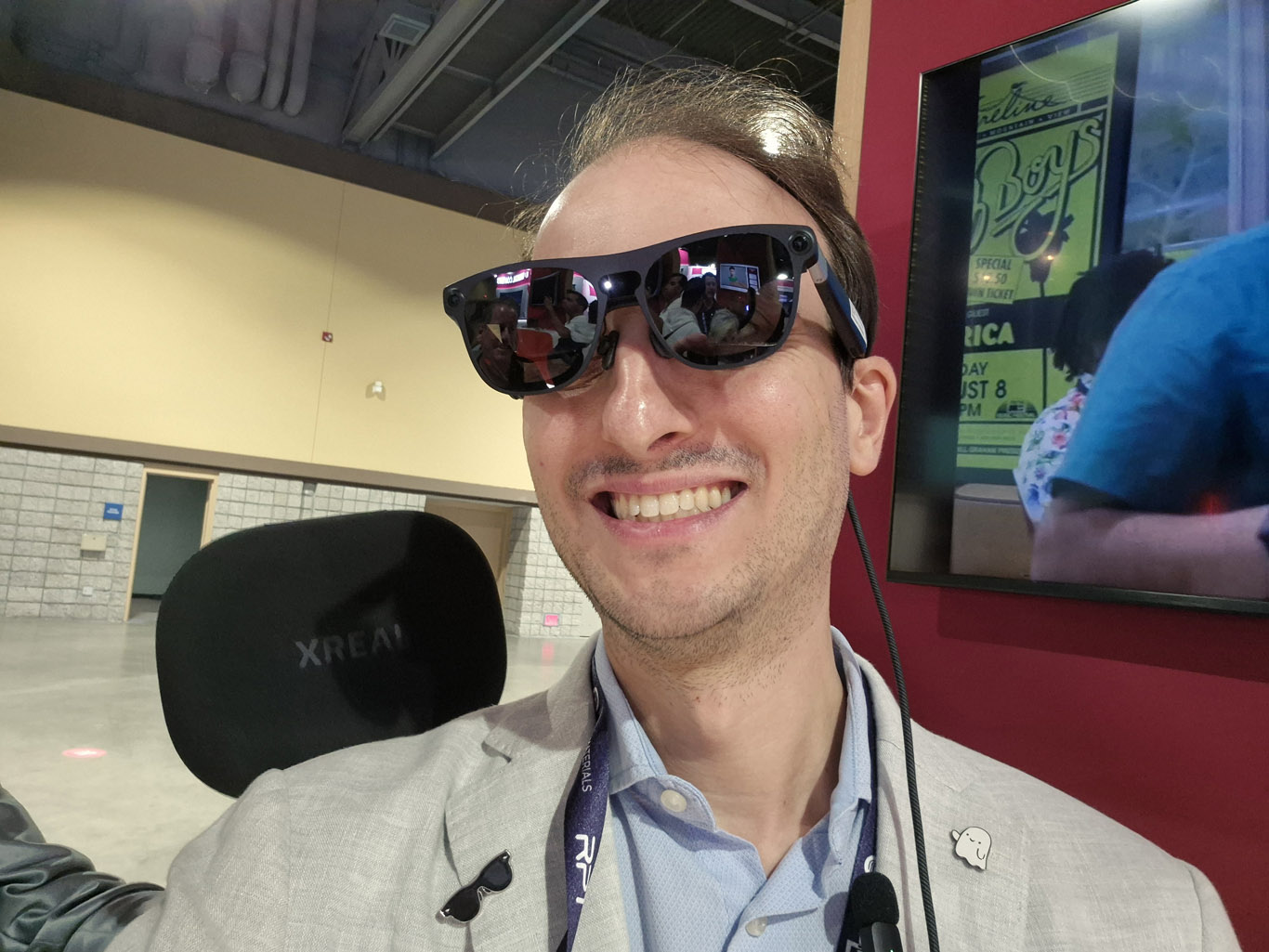
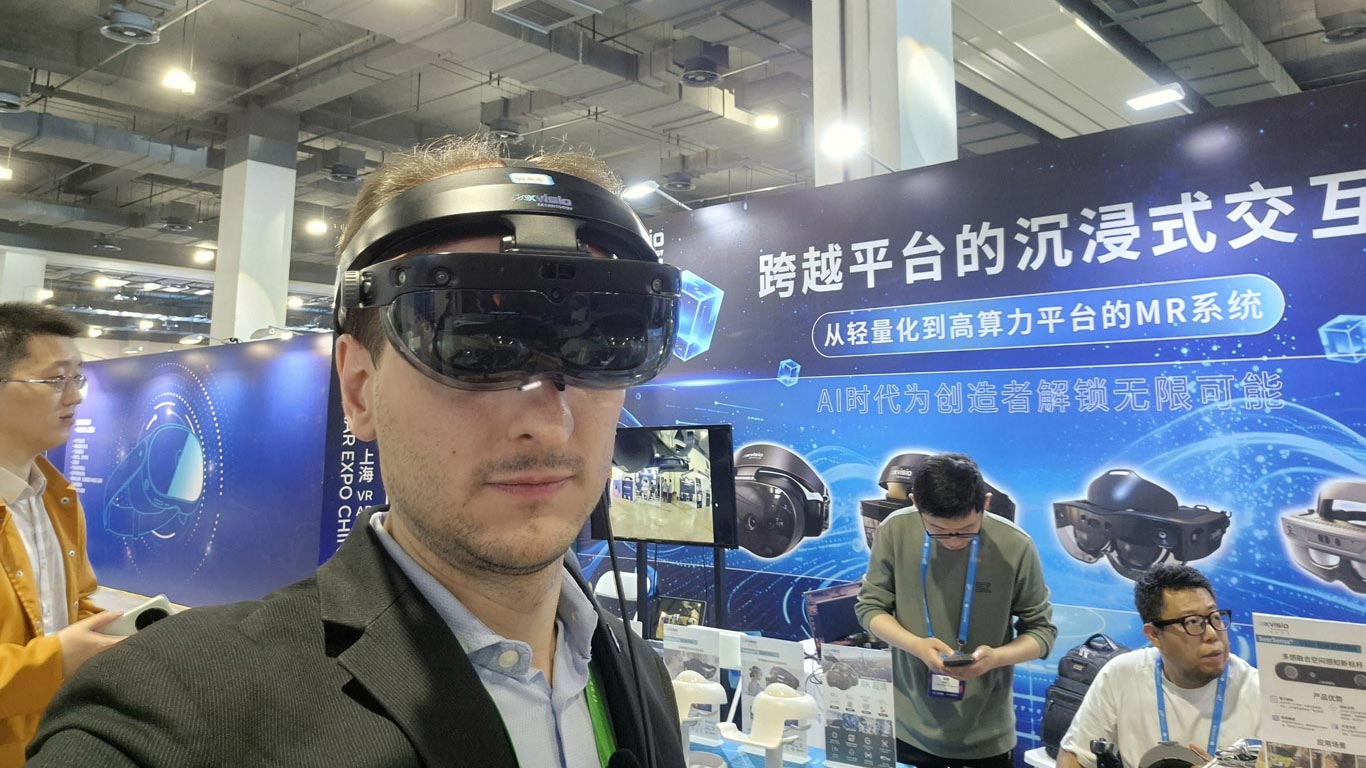
When I saw this headset, I thought it was smaller than other similar devices I tried. It didn’t look sexy, but being a headset for enterprises, that’s perfectly ok. Here are some photos of it, so you can see how it looks like.


When I put it on my head, I immediately realized that it was relatively lightweight and quite well balanced. The fact that everything was offloaded to the computational unit that was in my pocket made the headset very comfortable on my head. Even if I have to say that, since the SeerLens II B50R was made for Chinese people, it felt a bit uncomfortable on my forehead. As for the fitting mechanism, it was the classical halo around the head that you can close using a knob in the back. I’m not a fan of halos; usually, they never fit my head properly, but this is a common choice among AR headset manufacturers.

The shortcomings of the separated computational unit are the ones we all already know: I had to keep this box in my pocket, and I had this connection cable floating around. In my short demo, it was never a problem, though.
I was surprised to find, as a demo, the Unity MRTK demo, with which people usually demoed HoloLens. I guess this was made on purpose to show companies that they can really substitute their current HoloLenses with the SeerLens headsets. In the demo, I could grab objects with my hands and move them around, or I could press some buttons using my fingers. I learned that it was built using Xvisio AR foundation on Unity, which enables features like SLAM, plane detection, map sharing, and spatial anchoring.

The visuals were definitely ok. Colors were kinda bright, and the text was readable. I’ve found the FOV of 46° workable, but a bit small, especially on the vertical side. One big drawback of the visuals is that since this headset uses the birdbath design, it must have quite dark lenses, so I could not see much of the world around me. It was an augmented reality with the real world very darkened out.

Positional SLAM tracking was definitely good, even if probably slightly less stable than Microsoft’s. Hand tracking was working well enough that I could operate with the objects in the scene without any issue. But I noticed a very visible lag between when I was moving my real hand and when I could see the virtual hand reacting accordingly. This means that the hand tracking is a bit slow.

Xvisio SeerLens II B50H Max
The second headset I tried was the Xvisio SeerLens II B50H Max (another short and friendly name). This device is a 6DOF AR glass bigger than the other, but more performant. These are some of its specifications:
- Optical technology: Birdbath
- Display type: OLED
- FOV: 50°
- Resolution: 1920×1080 (per eye)
- Refresh Rate: 90Hz
- Brightness: 5000 nits
- Cameras: 4 fisheye, 1 depth, 1 RGB
- Tracking: eye tracking (in the B50HE edition), hand tracking
- Weight: 512g

This headset is an all-in-two device, too, so it needs to be connected to a computational unit as well.
Xvisio SeerLens II B50H Max hands-on
This headset looks definitely bigger than the previous one, and its shape reminds me much more of the first Microsoft HoloLens.


It is also slightly heavier, but in the short period of the demo, I had no problem with its weight, also because it felt quite balanced. A nice thing this model has, and the previous has not, is the flip-up design, so the eyes can be freed from seeing the headset by rotating the optical system upwards (like in the HoloLens 2).

Many of the other hands-on considerations that I did for the previous unit hold here. The differences I noticed are:
- The difference in FOV, even if minimal, was noticeable. 50° felt better than 46°. It is still a limiting FOV, though
- The colors appeared much brighter. This was thanks to the higher brightness of the display (5000 nits vs 3000) and the difference in contrast ratio (100,000:1 vs 10,000:1)
- The graphics looked more defined. This was because of the higher resolution of the displays (1920×1200 vs 1920×1080)

- Also, the tracking felt a tiny bit better, but I don’t know if it was only a sensation, because actually the tracking specs are the same between the two devices. Probably the fact that the display refresh rate was 90Hz vs 60Hz made everything appear more fluid to me, and this also helped in perceiving the tracking as more fluid.
In general, I preferred this device. The virtual elements looked sharper and more fluid, and there was also a tiny bit more FOV.
Price and Release Date

The two devices are already available in the market, and Xvisio told me that they can ship them worldwide, with discounts for bulk purchases.
The smaller SeerLens II B50R Pro costs around $4000, while the more performant SeerLens II B50H Max retails for around $5400.
Final impressions

It’s good to see some professional headsets that companies can buy to substitute broken HoloLenses. Xvisio seemed to me an interesting company that has a big expertise in manufacturing many types of XR hardware. The headsets looked solid, comfortable, and had bright visuals. Also, the fact that you can develop for them using Unity and AR Foundation (which is kind of the standard now) is a very positive thing for them.
The biggest problems for me are three: the lenses are a bit too dark, the FOV is a bit small, and the price is very high. HoloLens 2 was very expensive, too, but after a few years, I would have expected the price to go down a bit, especially if the glasses are using the cheaper Birdbath design instead of waveguides. The other problem I’ve been told by some American people is that some American companies can not work with Chinese hardware for data safety reasons. This may be a concern for companies operating in sensitive fields in the West.
Anyway, this was surely a great discovery for me. If you want to know more, you can head to the Xvisio website, learn more about these headsets, and send a request to the company. Or you can ask me for an intro, if needed.
(…and don’t forget about me, if you have to build your AR application for your company! Contact me for any XR consultancy needs 😉
Disclaimer: this blog contains advertisement and affiliate links to sustain itself. If you click on an affiliate link, I'll be very happy because I'll earn a small commission on your purchase. You can find my boring full disclosure here.