The best features of all the smart glasses I tried in China
In my latest trip to China, I tried a lot of smart glasses. Often, people ask me which one was the best, which is a question that is very hard to answer, because every glass has its pros and cons. So what I’m going to do here is list the features I loved most for the most important glasses I tried there, hoping this helps you better understand which device might interest you.
A note on the comparison
Before starting the article, let me clarify the reasoning behind it a bit.
I tried many smartglasses, but these smartglasses all have similar functionalities and use cases (translation, listening to music, AI assistance, etc.). At first glance, they all look the same. So what I’m trying to do here is to show you what is “special” about every device I tried, that is, what, in my opinion, is the “superpower” of every glass that makes it different from the others, so that you can understand what device suits your needs the most.
Notice that this is not an exhaustive review of the glasses: it just highlights what they have as an edge against the competition. Also, remember that I tried most of them for just a short time, so I may have missed some important detail that I could only discover when using them for a long time. The article doesn’t list all the glasses on the market, but only the most relevant ones I tried in China (so there won’t be XREAL because I did not try it on my latest trip).
Now that everything has been clarified, we can start!
Huawei AI glasses

Huawei clearly delivered a great product with its AI glasses, which have been designed with a lot of attention to detail (as I explain in my review).
The thing that I liked the most about them is their ability to shoot amazing photos and videos. The glasses shoot pictures in a raw format containing a lot of data, and when they are moved to the phone, some AI magic creates the final photo that is very crisp and colourful. Videos are stabilized, and even videos taken when running look very smooth. This is crazy good.

Another thing that is great about them is the all-day use: the glasses are very lightweight, and the battery lasts 12 hours (of mixed use). They have been engineered to be worn all day.
Talking about minor superpowers, I also liked the privacy feature of the audio, with the glasses emitting an inverse wave of the audio you are listening to so that external people can’t hear what you are listening to. And then they are waterproof… I mean, waterproof for real…
Rokid
Rokid is one of the Chinese companies with the longest experience in making XR glasses. And this is clearly visible in its products.
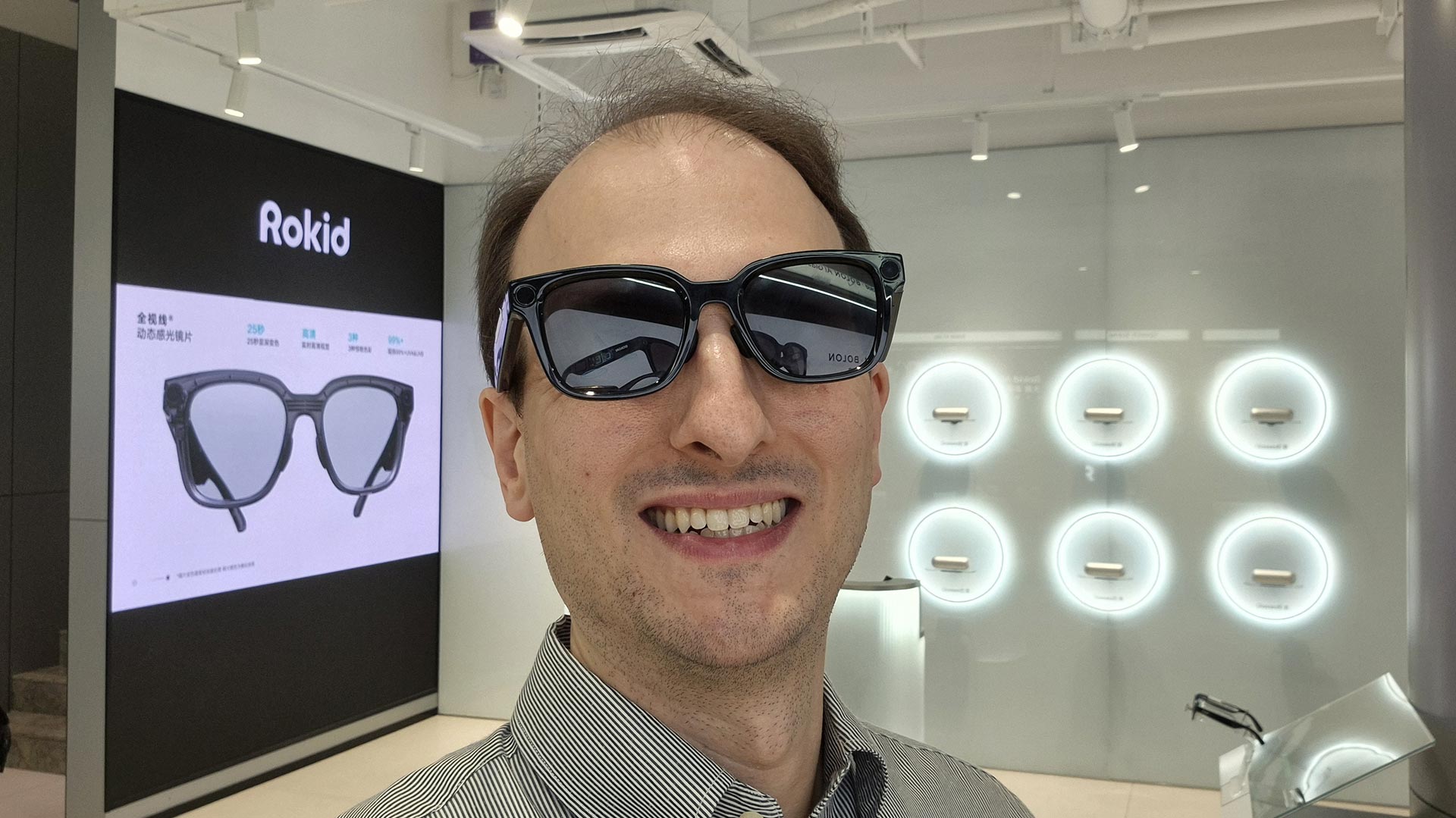
One of the things I loved the most about the Rokid glasses is their style. Rokid is the only Chinese company that partnered with an eyewear company, Bolon, and so its glasses are, in my opinion, quite beautiful. They are for sure the ones that suit my face more among all the ones I’ve tried in China, as you can see from the picture below and also the header of this article.

One other thing that I could appreciate from Rokid is that its glasses really look like mature products. There is already an SDK, a Store, various integrations with Chinese services, and they are also opening up to agents/skills working with OpenClaw. And since they have been in the market for a while, there is also already a community of developers. They are not a company entering the glasses field; they have already been doing glasses for years at this point.

I would also mention the fact that these glasses are also sold in the West, in contrast to other glasses listed in this article, like the Huawei ones, which are available only in China.
Alibaba Qwen Glasses
The tech giant Alibaba entered the smartglasses market with its Qwen smartglasses with a display. Alibaba is not used to making hardware, but this still looks like an interesting first step.

The best thing about the Qwen glasses is most probably the integration with the Alibaba ecosystem. I know that this may not sound that important to all my Western readers, but actually, for people in China, this is huge. Alibaba provides some of the most used services, like Alipay for payments, Amap for navigation, and TaoBao for online purchases. Glasses that are fully integrated with all these services are going to offer huge advantages for their users. And Qwen glasses are integrated with all of them.
One other thing that impressed me is the display brightness: with its 4000 nits, I was able to see the monochrome green text even when I was looking at the sky from the window. These glasses are definitely good for wearing outdoors.

Talking about the battery, the cool thing about these glasses is that the battery can be swapped. You can wear the glasses while you charge a small spare battery in a dedicated charger, and when your current battery is worn out, you can change it on the fly with the charged battery. This way, you can use the glasses without interruptions. Pretty cool stuff.

INMO GO3 Glasses
INMO is ending in these hours a very successful Kickstarter campaign about its Go3 lightweight glasses.

These glasses are heavily focused on translation. And regarding translation, they have some very cool features, with one of them being that 9 languages can be translated fully offline, without the need for an Internet connection. This is not possible with most of the other smartglasses and can be very useful if you plan to use these glasses abroad in locations where the connection may be a problem.

These glasses feature a swappable battery design like the Alibaba Qwen glasses. But the thing I’m most interested in is that they can work together with a ring. I’m personally a fan of having interactions through a ring, because rings are very discreet and comfortable to use and don’t require you to raise your hand for every interaction you want to have with the glasses. Unluckily, I couldn’t try the ring at the event, so I can’t comment on how good it is.
TCL RayNeo Glasses

When I went to TCL, I was able to try a few glasses of the spinoff company RayNeo.
I think that the best feature of the RayNeo glasses with a display is the display itself. Both the RayNeo X3 Pro and the RayNeo GT feature displays that are very bright and have great colors (yes, they are RGB displays). I’ve already reviewed the RayNeo X3 Pro, and I totally loved the displays on it. I could even use it outdoors to have live navigation instructions. The problem for the X3 Pro is that these displays come at a price (the glasses cost $1500). Luckily, the other glasses by RayNeo are far cheaper.

The RayNeo X3 Pro can also provide some sort of 6-DOF tracking… it is very inaccurate, but it is still impressive that they can provide that feature with only one camera.
But the real killer feature comes with the RayNeo Air 4 Pro (which are media consumption glasses), that come in a limited edition with the covers of Batman and Joker. This is one of the coolest things I tried in XR in the past few months…
Mentra Live
Mentra is technically an American company, but it has offices in San Francisco and Shenzhen, and I was able to try its glasses in China.

What I love about Mentra Live is their software ecosystem. Mentra is building MentraOS, which is a sort of “operating system” (for now, it is an app that runs on your phone) that supports different glasses, like the Mentra Live and the Even G2 glasses. Thanks to this, you can develop an application once, and it can run on multiple glasses.
Mentra is a fully open ecosystem, so you can do what you want with the glasses. You can develop applications for them and make them work with your custom AI, even a local one you run on your own servers. This can be amazing for companies that don’t want to share their data with an external company.

Hardware-wise, the Mentra Live glasses are very lightweight, so they are meant to be used for many hours. You can even keep them connected all the time to a battery pack, so ideally you can wear them all day (but with a tether, of course).
Oran Osee

These glasses from a Chinese startup are not the best on the technical side (they just mirror your phone screen in a rough way), but I love their cyberpunk style. I think we need more companies experimenting with different styles!
Holoswim

The smartglasses I’ve listed until now are meant for general-purpose usage. But I see a future also for glasses that are built for specific use cases. Holoswim belongs exactly to this category: these are simple glasses built just for people who want to measure their performances while swimming. And for this specific use case, they are better than all the others, of course (also because most of the others could not even survive underwater…).

And that’s it for this comparison of all the most relevant glasses I’ve tried in China! If you have any questions about these devices, feel free to ask them in the comments. And if you want to collaborate about integrating these glasses into your business, feel free to reach out to me, and I’ll be glad to help 🙂
Disclaimer: this blog contains advertisement and affiliate links to sustain itself. If you click on an affiliate link, I'll be very happy because I'll earn a small commission on your purchase. You can find my boring full disclosure here.