Snap unveils Specs: exclusive interview with the company, and some insights from the show floor
Today was the big day: Snap finally announced on the stage of AWE the Specs glasses, the first consumer-oriented AR glasses. I guess you’ve already read the news somewhere else, but let me give you some insights I got about it directly from AWE, plus show you an interview I had with the head of developer relations. And of course, let me also give you my point of view about the glasses, the price, and the potentialities of this device. I’m pretty sure you will find this post pretty interesting even if you’ve already heard about the announcement…
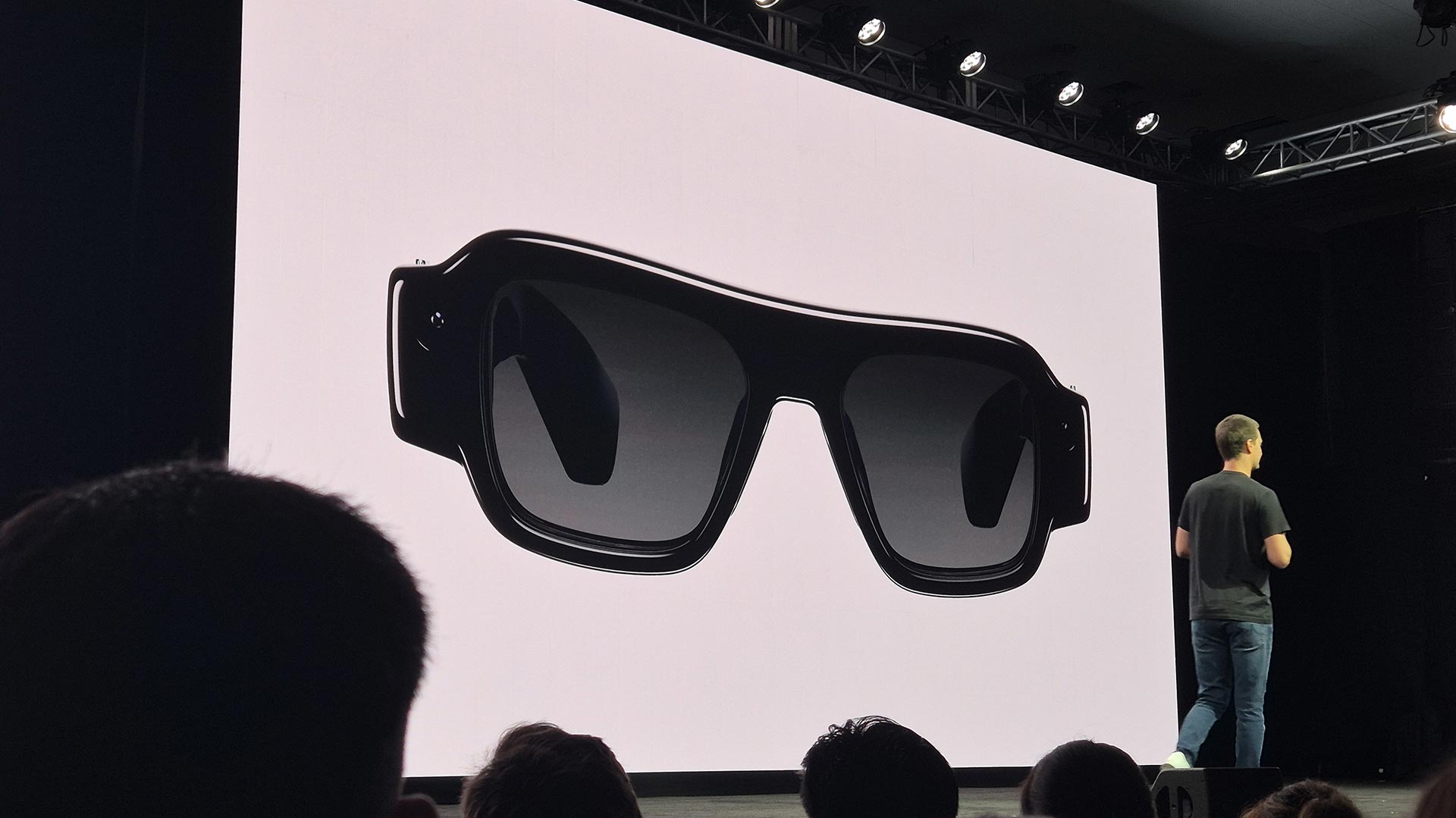
Snap unveiled Specs
Let’s start with the main news: Snap has finally unveiled its Specs glasses. These are the main things we learned about them (courtesy of Road To VR):
- Field of View: 51°
- Display Technology: LCoS
- Color Reproduction: 16 million colors
- Lens Type: Electrochromic (auto-tinting), 10 seconds transition time
- Processors: Dual Qualcomm Snapdragon chips
- Motion-to-Photon Latency: 7 ms
- Battery Life: Up to 4 hours mixed use
- Number of charges offered by the case: 4

- Input: Hand tracking
- Material: TR90 polymer
- Sizes: 47 mm and 52 mm
- Weight: 132 g (47 mm), 136 g (52 mm)
- Prescription Support: Removable prescription inserts
- Connectivity Features: Bluetooth notifications
- AI Features: AI assistant
- Privacy Features: On-device processing, recording indicator LED
Snap involved a lot of resources to build them, and it filed 7,000 patents related to Specs.

Regarding the price, which was the big unknown, it will be $2,195. The devices are expected to ship during fall 2026 in US, UK, and France.
This is a very condensed summary of the news, and you can find a more detailed explanation in magazines like Road To VR and Upload VR. Now let me dig into my more unique insights about this launch.
No hands on the glasses
I had a meeting set up with Snap for after the keynote, and I was sure I was going to try the glasses. Instead, I could not. I thought that I could not try them because I am just a blogger, but then I learned that not even the journalists from important magazines could try them. No one could. We could not even touch them. The only thing we could do is see them inside a transparent box. So I did the best thing I could do for you and shot a few pics about the product:


And here you are a short video I took of them from all the points of view:
Everyone at AWE was confused about why we could not try the glasses. Some people speculated that the glasses are not working yet. I managed to get some insider info and discovered that, actually, the glasses are working, so Snap has not launched something it doesn’t have in its hands. So my best guess is that they are working but not polished yet, and the company was afraid that some bugs might surface when some important journalists were trying the device, which could have hurt the product’s reputation (and the company stocks). It makes sense, but still, I’m a bit disappointed because I really wanted to try them.
My interview with Snap
I couldn’t go hands-on with the glasses, but I could have a very quick interview with Joe Darko, the head of developer relations at Specs. I asked him about the device, the high price, and the opportunities for developers. You can find the video of the interview here:
I liked speaking with Joe because he clearly has a lot of passion for the glasses and for working with developers. I think it’s also interesting that he highlights in the interview how they are aware that this is a product for early adopters, and not a mass market one. It’s a bit like when Apple introduced the Vision Pro: a device packing a lot of innovative technology, and so not a cheap one.
The company is constantly finding ways to introduce developers to its ecosystem and to make them happy, and it is interesting that they are actually listening to every piece of feedback: last time I met them, I complained about the lack of Unity compatibility, and this time they announced a conversion tool between Unity and Lens Studio.
Development Tools
Unluckily, I missed the speech of the CTO of Snap going into details about the development tools, but I can tell you what I learned from the main keynote about how to build for this device.
The main development environment for Snap Specs is still Lens Studio. On the occasion of the launch of Specs, Lens Studio got a new logo… many people cheered at it, but it is just basically the old logo that, instead of being yellow, is like made of reflective glass. I guess they paid someone a lot of money for this logo, but I probably could have done the same with a Nano Banana Prompt… but that’s a topic for another day.

Snap introduced agentic AI development for lenses, with integrations with the most popular tools for AI-assisted development, like Claude Code. This is great to help people who are a bit less technical to create experiences for this device by just vibe-coding them. They called this “Closed Loop Agentic Development”… probably because AI Loops are the big trend of the moment.

Snap also announced an interesting agent to convert Unity projects to Lens Studio projects. This is not the Unity support I’ve been asking for, but at least it is a step forward towards us Unity developers.

They also announced the “Native Development Kit” that lets you integrate native libraries (C++ ones) into Lens Studio. This is amazing for existing libraries that require low-level access and can now be used to create lenses.

Two curiosities about the keynote
There were a couple of things that made the keynote a bit more “human” to me. The first was when Evan made a joke when presenting the capabilities of the headset. He presented Specs as the only device that is capable and wearable, showing the usual graph with two axes and four quadrants. I was wondering what device they would have put in the infamous “not capable, not wearable” quadrant, and then I discovered it was… a potato. I love jokes about potatoes, and this was a pretty unexpected one in such an important keynote, so I loved this moment.

The other thing I remember is when, after a lot of blabla, it came the moment Evan Spiegel had to actually announce the glasses. And in that exact moment, his voice broke up a bit. I loved that moment: usually these CEOs make presentations like robots, while in this case, he was so genuinely emotional that he had a little difficulty when speaking. It made him look more human to me… and I also felt better thinking about all those times when I had some problems when speaking in public: if even the CEO of Snap sometimes can get emotional when speaking in front of an audience, I think it is legitimate we have some problems too!
The reactions from the attendees

During the keynote, there were all Snap people screaming with joy at every announcement, but what were the real reactions of AWE’s attendees?
Well, speaking with other industry experts and journalists, I got an unanimous feedback: the price is too high for mass adoption, and this is just a device for a few early adopters. Which means it won’t move the needle of the AR/VR ecosystem much. The other complaint I heard is that it is too big and heavy, and this is for sure not something you can keep on all day.
On the positive side of things, everyone was generally happy that Snap finally launched a new device on the market.
My impressions on Specs’s launch

My opinion about this device is similar to that of other attendees. The price is a huge problem. As a tech guy, I can understand why it costs too much: when you build innovative technologies, you can’t produce cheap devices. It’s perfectly normal. But at the same time, the users don’t care about the reasons why something has a specific cost, they just care about how much money they have in their pockets. So, while it is true that this device is cheaper than the Vision Pro, that may have a price compatible with the iPhone at launch adjusted for inflation or things like that, if someone has not $2200 in their pocket to spend on AR glasses, all the words we can say on the matter have no importance. Simply, this person won’t buy the product.
In my city, $2200 is more than the monthly salary of an average person. If someone has to spend that money should be for something with a clear value, a clear use case: e.g. a scooter that he/she needs to go to school. Spending $2200 for glasses that can show some fancy “lenses” is today not a use case that justifies that amount of money. Period. Unless Snap manages to find some “killer use case” for its glasses, this will be the situation.
Not to mention the fact that the glasses are indeed pretty bulky, and so most people wouldn’t like to wear them outdoors. And since they weigh more than 130 grams (which is much more than the suggested threshold of 50 grams), they are not suitable to be worn for a long period of time, which hurts their usability for tasks like productivity.
So I personally find it very hard to think they can sell very well. They can target the usual market of Snap fanboys, AR fanboys, tech enthusiasts, developers, and creators. This is a niche, and most probably these glasses will sell something like 200,000 units. The other opportunity would be the enterprise sector, where companies have no problem spending $2200 for a device. But it has to be seen if the enterprise world would be happy working with glasses offered by a social media company. Plus, being the glasses big and not suitable to be worn for many hours, this would limit their use for tasks that do not take much time, and this is quite limiting.
So I’m pretty sure Specs won’t be the saviour of XR this year. These glasses are not going to change much of the XR landscape, because only a few people will adopt them.

But it’s not all about bad news here. It is cool that Snap launched a new AR product, and for the first time, it is not officially a dev kit. I mean, it is actually still a devkit, but now we have started going into something that is more similar to a product also for other categories of users. And it is even cooler that it is 10 years this year that Snap has been working on these AR glasses, starting from the first Specs that had a fancy shape and just a camera. These guys are here for the long run, and clearly, Specs are not going to be their last device. So while I’m not so excited for the potential commercial success of Specs today, if I look back at the evolution of Specs in the last 10 years, I’m very positive about the next iterations of the device. And probably the 3rd generation could start having a price that can really get the interest of the average consumer.
Also, I have to say that the glasses seem genuinely well made. Unluckily, I could not try them, but they look very well-manufactured. And while they are bulky, I kinda like the style. They genuinely put some effort into it, and I’m pretty sure that lens creators, who are Snap’s community, will love them.
I also loved the attitude of the people of the company I’ve spoken with: they were all excited about the product and about creating a good ecosystem around it. It was especially nice to see that they wanted to create a great community of developers around them.
Since I’m a developer, I would also like to write a short comment about this. The big problem from my point of view is that if a device costs $2200 and has little consumer adoption, there are not enough potential customers to sell the app I develop to. So I find it hard to justify spending some time creating content for it. I can do some experiments out of passion, but there are clearly not enough people to create a sustainable business on Specs. And Snap has to do something out of it, providing developers and creators all the incentives it can provide... ideally, even funding for developers wanting to create innovative lenses. Also, I would love to see some compatibility with Unity and potentially also OpenXR, so I could finally just develop my AR/VR applications only once and then they could run on the Specs, too.
In general, I think this launch has been a net positive: it’s great to have a new device coming to the space, and it’s great to see that Snap is still committed to AR. But I also think we should have realistic expectations about it: this is not the saviour of XR, but it is one step forward in the right direction for the whole space.
Disclaimer: this blog contains advertisement and affiliate links to sustain itself. If you click on an affiliate link, I'll be very happy because I'll earn a small commission on your purchase. You can find my boring full disclosure here.