Oxford Optical Labs aims to make varifocal headsets possible
One of the startups I absolutely wanted to visit at AWE was Oxford Optical Labs (OOL) because it is developing special lenses that can change their focus on demand. This company got me intrigued since the first time I spoke with them during my AWE preview interview, because its technology could enable varifocal headsets in the future. Let me tell you everything that I learned when I visited their meeting room at AWE in Long Beach!
A lens that can change its parameters
Oxford Optical Labs has been working on its adjustable fluid lenses for over 20 years. These lenses are not made of glass, but are made of a membrane that contains a fluid. By changing the parameters of the fluid, it is possible to change the parameters of the lens. For instance, the same lens can be used first with someone with myopia, and then with someone with presbyopia.
In my previous article, I stated that the lens changes its property thanks to electricity that flows through it, but that is incorrect. The lens changes its property because of pressure in some specific points. So changing these “pressure points” on the lens changes its property, and the same lens can be adapted to any person needing it. As you can see below, it can be altered to change all the possible optical properties, and solve myopia, presbyopia, and even astigmatism!
Hands-on OOL fluid lens
At AWE, I was able to see one of these lenses. You can see a picture I made of it below.

The rear part of the lens was completely rigid, while the front of it was softer. The consistency reminded me a bit of an antistress toy, or a balloon very full of water. In the middle, there was the fluid that made sure the optical properties of the lenses were as needed. People at OOL told me that even if the lens looks soft, it is actually very resistant, and they have some lenses in the lab that have resisted for more than 15 years. The lens is definitely as resistant as the one that people have on their glasses nowadays. And even if it breaks, the liquid inside is nontoxic, so no one is going to die.
Since I am me, I have decided to verify their claims by tapping on the soft part of the lens, first with one and then with two fingers. I can confirm that, notwithstanding its softness, it didn’t break. This is good news for OOL and also good news for me, because it means I didn’t have to pay damages to the company for breaking something.
After this test, the company gave me a test lens, and an insert to attach to the lens. The test lens had a circular ring with some magnets on it. The insert (which is officially called the “deformer”) had a similar metallic ring, and when I put the two close to each other, the magnets of the first ring attracted the ring of the second, and they snapped: the lens and the deformer became one entity. The interesting thing is that after this happened, the lens had changed its optical properties. You can see this sorcery happening in the video below:
It took me a while to understand what happened there. The thing is, the insert has a shape that is extruded out of it, and when it snaps onto the softer part of the lens, this plastic extrusion presses on the surface of the lens, deforming it. Depending on the shape profile of the extrusion, hence its pressure profile, the lens assumes some specific optical parameters. So a base lens can assume different optical properties depending on which deformer is applied to it.

As you can see from the video above, it works. The lens changed its focal point and various optical parameters by just applying a pressure pattern on it. Oxford Optical Labs has in its labs some specific machines to measure with great precision the parameters that have been changed. And it told me that it can modify not only the presbyopia/myopia parameters, but also the ones related to astigmatism.

I didn’t know, but it seems that astigmatism is still an important thing to correct for VR users. Even a very mild astigmatism of 0.5 diopters may limit the user’s perceived resolution, reducing it to as low as 13 PPD. Considering that Quest 3 has around 25 PPD, this means that a non-corrected astigmatism may impact the perceived resolution by half!

From customized glasses to varifocal XR headsets
The vision of the company is to use its technology to help in building varifocal headsets. But this is too ambitious a project to start with, so the idea is going step by step.
The first step could be having customized glasses in locations. OOL could build an add-on for headsets (like the current prescription lenses for VR headsets) and give them to museums, LBVR locations, and other places where headsets may be used by the public. When a new user comes, he/she can provide his/her own glasses to a steward. The steward would put the glasses under a dedicated machine that would “read” the current prescription of the user and modify the OOL fluid lenses to adapt to the user’s prescription. This may happen through many small screws around the edge of the lens that could be tightened and loosened until the required pressure pattern is created. The output of this would be that places providing location-based VR experiences shouldn’t have suitcases full of prescription lenses anymore, but they would just need a bunch of OOL lenses that could adapt to every user on the fly.

The second step could be integrating these fluid lenses directly with the headsets. If Meta or Pico partnered with OOL, these lenses could be shipped inside the headset, maybe already with a mechanism to configure the prescription. Imagine if you could configure your prescription by just using a small dock for your lenses. That would be super handy.
The third and final step would be the one of having the headset with the integrated lenses that are not only used for prescription correction, but also to let the user dynamically focus on the objects he/she is seeing in VR, solving the vergence-accommodation issue. Finally, the eyes of every user could focus on the virtual elements, no matter the prescription, and no matter the distance of the virtual object. We would then have varifocal headsets: the Half-Dome dream may become real.
How would varifocal work?
Varifocal would be the last step because it wouldn’t be easy at all. The system would require eye tracking to track what virtual element the two eyes are looking at, and then a dedicated system that quickly applies the pressure to the lenses so as to make them put that virtual element into focus. Making this quickly and reliably is already a challenge by itself. But there is more.
If you would just apply this mechanism naively, the brain would notice that constant re-adaptation of the focus and your experience would be absolutely unpleasant. So the trick is exploiting the saccading movement of the eyes. When the eyes are moving from one point to another, the brain ignores their signal, because it would be too noisy and blurred. So the trick would be to exploit this moment of “blank” to quickly change the parameters of the lenses to what will be required by the destination of the movement of the eyes. So the whole system should:
- Detect that the eye is going to move.
- Calculate where the eye is moving.
- As soon as the eye starts to move, quickly change the parameter of the lens to fit the estimated destination of the eye. The brain is ignoring the eye signals, so we can do it without problems.
- Detect when the eye has finished moving.
- Calculate the difference between the prediction and the actual eye position.
- Do a fine-adjustment of the lens parameters so as to fit the real position. The adjustment should be small enough that there is no discomfort for the user.
In theory, all of this should work: there are papers that confirm that all of this is doable. Even the timing is fine: Oxford Optical Labs claims it can change the parameters of the lenses in around 70ms, and the saccades movement is usually above 100ms. But one thing is the theory and the other is the practice. And one thing is making a prototype, and the other is making a product that has to work every time, for every user, for many years. It’s a bit of a moonshot.
OOL is currently having conversations both with eye tracking companies and headset companies to see how they could collaborate.
Hands-on the varifocal lenses
I have been able to try a sort of manual varifocal AR display made by Oxford Optical Labs. I couldn’t shoot pictures of it, so you have to rely on my words and the videos shot by the company.
I put my head inside a pretty bulky machine that reminded me of those machines used by the opticians to evaluate your optical parameters. I put my chin on a stand, and then I just made my forehead lie on the machine. In front of my eyes, there were two transparent waveguide displays (one per eye), and each of them was associated with two of the fluid lenses made by the company, one before and after the waveguide. If you are wondering why there were two lenses for the display, the reason is as follows: if there was only one lens to modify the focal length of the display, the same lens would also distort my perception of the real world! So we need one lens (the one before) to modify the display focus, and another one (the one after) to correct the vision for the real elements back to normal (basically undo the optical distortion of the first lens for the real world). In front of me, there were three objects at three different distances. Close to me, there was a business card, then there was another object at mid-distance and another at a longer distance.
The machine was made to put three virtual labels on top of the three physical objects: so one close label, one at medium distance, and one at “far” distance.
When the machine was turned on, its setup was like today’s AR glasses: the focus was set at a fixed 2-3 m of distance, which was the distance of the farthest object. So I could put in focus both the distant physical object and the three virtual labels. All the labels were in focus together with the distant object. If I looked at the medium and close object, their respective labels went out of focus.
I was then given a cute mini keyboard with just three keys (It was so cute that I wanted one too! So I asked them where they bought it, and they gave me this link lol). The people from OOL then switched the machine to the varifocal mode: using the mini-keyboard, I could manually set the focus to close, medium, and far. And it worked! When I selected the close range, both the close virtual caption and the close real object were in focus at the same time, and all the rest was out of focus. The same happened with the mid-range object and the far object. Everything was functioning as promised. I could even focus on close virtual objects, something currently impossible with AR glasses.
This test proved to me that theoretically, OOL lenses could be used for varifocal AR glasses. But still, this was a very rough prototype. The change of focus took much more time than 70ms, and the machine made a very heavy mechanical noise when changing the focus. It was like many little squirrels were grinding to change the focus of the lens. I don’t think we want the same squirrel army to work in a headset. Plus, the labels and the virtual objects had a very tiny focus difference, but this was probably a little calibration mistake for the test. Anyway, apart from these small issues, the system worked, and it proved to me that Oxford Optical Labs lenses could really be used for varifocal AR one day.
Final Impressions

Oxford Optical Labs showed me a very interesting technology: they can build fluid lenses that change their optical problems. This technology already works, and among some of their use cases, they are thinking about integrating it in virtual and augmented reality headsets to provide configurable prescriptions and varifocal vision.
I am pretty much convinced this startup could deliver some adjustable prescription lenses for headsets. I’ve been able to test their technology, and it works: the lenses really can change their optical parameters and help users to focus on objects. Their vision of add-ons for XR devices, potentially used in public demos, is a concrete one. And it would be very beneficial for all those entities that need to adapt headsets to users who visit them.
Regarding varifocal in XR headsets and glasses, I hope it can work, but I think it is currently quite distant. Theoretically it can work, but going from theory to a product may require many years. And even if this would be technically feasible, we would still have to understand if these lenses are actually the best approach, or if there is something else that would be better suited, like materials that change their properties depending on electrical stimulation.
Anyway, I still think that my visit to Oxford Optical Labs was definitely super interesting, and I will keep an eye on its promising products.
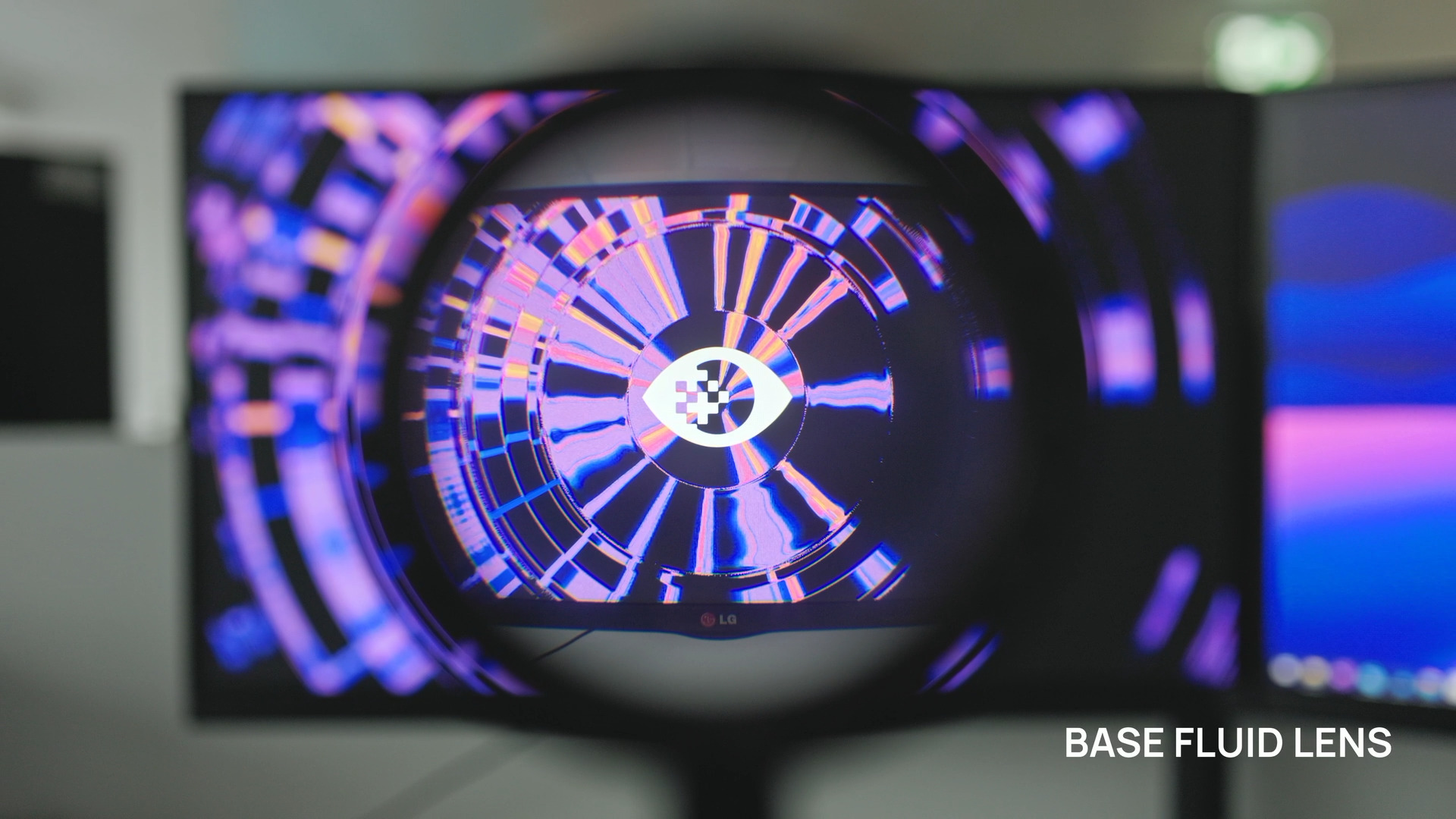
(Header image by OOL)
Disclaimer: this blog contains advertisement and affiliate links to sustain itself. If you click on an affiliate link, I'll be very happy because I'll earn a small commission on your purchase. You can find my boring full disclosure here.