The Vector Gear aims to be the VR makers’ dream open headset
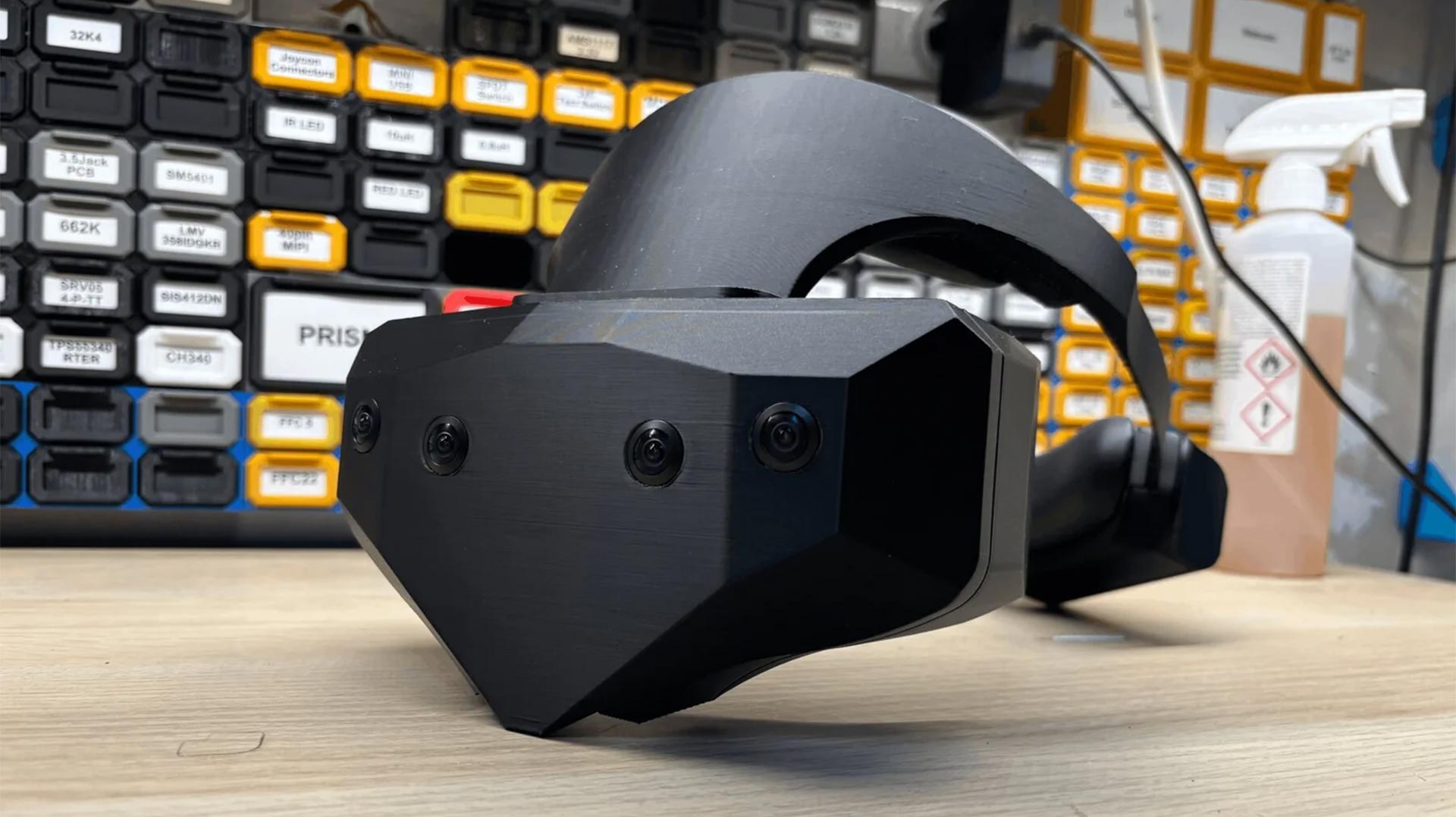
It’s been a while since the first time I read about the Vector Gear, the fully open mid-range headset built by Walker Industries. This project got a lot of praise from the community and has recently launched a Kickstarter campaign. Let me tell you what makes it so cool and why it deserves your consideration.
The Vector Gear project

Walker Industries is a company made up of VR makers. In the Kickstarter video, the head of the company says that he had the dream of building a headset since when he was like 13 years old and was watching Sword Art Online. 9 years later, he’s trying to make his dream reality, by building himself together with a bunch of other talented nerds a fully opensource headset packed with features: the Vector Gear.
When I say packed with features, I really mean it:
- The Vector Gear is both standalone and PCVR
- It has a dual chipset architecture, so that one chip is dedicated to tracking and the other can run the applications
- It has controllers that track themselves via inside-out tracking à la Quest Pro
- It features face tracking, with OSC for integration with VRChat
- It has automatic IPD adjustment
- It features a dedicated open-source OS with some cool cross-device features (more on this later)
All this together makes the headset a dream from enthusiasts, especially if you consider that the whole hardware and software will be opensourced, so you’ll be able to do with it whatever you want.
It’s pretty crazy that a small team in Japan was able to deliver all of this with very limited funding. It’s basically Pimax-like ambitions, but at 1-hundredth of Pimax’s budget.
The specs: Vector Gear vs Andromeda

The Kickstarter campaign mentions actually two headsets: the Vector Gear and Andromeda. Vector Gear is the flagship headset, that works both as a standalone and a PC VR device, while Andromeda is PC VR only. Andromeda comes in two versions: one is pretty cheap for people on a budget, and the other is pretty expensive for people wanting quite high visual definition.
This is a recap table of the features of the three devices:

The Vector Gear, thanks to its versatility, is the one that I personally find the most intriguing. The specs are not that bad for a headset released in 2026. They are not stellar either, considering that the resolution is in the same ballpark as Quest 3 and Steam Frame.
This is a longer list of specs, in case you want more details:
Vector Gear:
- Displays: Dual 2160 × 2160 TFT LCD panels at 90 Hz.
- Optics: Dual combined Fresnel (“pseudo-pancake”) optics.
- IPD: Automatic adjustment.
- Main processor: Qualcomm Snapdragon 8cx Gen 3 with 8 GB RAM.
- Co-processor: Rockchip RK3588S with 8 GB RAM, specifically for SLAM, face tracking and developer modding
- Tracking: Inside-out SLAM for headset and controllers (Controllers use RK3576)
- Cameras: Two monochrome SLAM cameras, two global shutter colour passthrough cameras, two internal eye tracking cameras and one internal mouth tracking camera.
- Face tracking: Full face tracking, including eye and mouth data.
- Battery: 85 Wh Amprius silicon cell power soruce
- Audio: Integrated audio system (Still choosing speaker) and dual microphone array
- Charging: USB C Power Delivery.
- Connectivity: Wireless PCVR streaming.
- Controllers: Inside out tracked controllers with an RK3576 processor in each controller.
- Operating system: YuukOS, an Arch-based XR distribution, with XRUIOS as its spatial computing layer (Works with Windows/Linux Steam, Monado driver WIP)
- Software compatibility: FEX x86 emulation and Proton compatibility layers, with console emulation under discussion

Andromeda:
- Display options:
- LCD: 1600 × 1600 per eye.
- Pancake OLED: 2560 × 2560 per eye (Although limits of 1920×1920 @ 90hz upscaled and 2560×2560 @ 75hz, the company is looking for alternatives that are the same price but can do more)
- Optics: Pancake optics on the OLED configuration.
- IPD: Automatic adjustment.
- Tracking: Inside out headset and controller tracking using SLAM.
- Face tracking: Supported
- Compute: RK3588S based SLAM and wireless PCVR processing.
- Wireless PCVR: Designed around wireless streaming and foveated streaming
- Battery: 45 W class Amprius silicon cell battery; a 7+ hour runtime is a development target and remains in progress.
- Expansion: Shares the Vector Gear’s intended open and moddable hardware ecosystem.
In-house development
What I’ve always found crazy about this project is that not only did Walker Industries come out with this idea of building an opensource headset; not only did they decide to add very interesting features like face tracking; but they also decided to build the software modules by themselves. Like, the eye and face tracking algorithms have been built in-house. This is incredibly cool, considering the size of the team.
The face tracking is named “Shinra Meisin” and has been integrated into the headset because the creators think that animating the face of the user’s avatar in social worlds like VRChat is of paramount importance. In fact, it can stream its data via OSC, so that you can already use it inside VRChat.
The tracking system is called “AstroSLAM” and it is implemented both in the headset and the controllers. It’s pretty cool to me that controllers offer inside-out tracking via onboard cameras because this makes them very versatile. Inside-out tracked controllers can track their position even if they are behind your head, or even if you put them on a prop and use them for object tracking. You can’t do that with your Quest 3 controllers. And again, this tracking system has been built in-house. Tracking is fully compatible with SteamVR, so you can use both the headset and controllers with your favorite Steam games.
Talking about tracking, the company has received requests for implementing also Lighthouse tracking, and they are considering the idea of a custom faceplate or something like that.
The XRUIOS Operating system
Since all of this was not enough work (lol), Walker Industries also proceeded to create a custom operating system for its headset, based on Arch Linux. This is an operating system completely built for VR, and the company defines it as “Garry’s Mod fused with a spatial runtime”. Basically in it, you can move 3D objects around to create your home, add widgets, run VR applications from Steam, run VR applications from a custom Walker launcher, and so on. It integrates FEX, so you can launch your standard X86 applications even if the headset is an ARM64 running Linux. One of the widgets is also an emulator of MS-DOS, so you can even run your old games in it!
XRUIOS also features a thing called the Yuuko Protocol which is a super complex system, but trying to keep it simple, I can say that it is a cross-platform tool to create a cohesive and continuous experience between devices. An example here can make it very easy: thanks to Yuuko, if you are playing a music file on your VR headset, and then you pause it, then you can open the same file on your mobile phone and restore the playback from the exact same position you paused it on your headset. The idea of the Yuuko Protocol is that all your devices (PCs, smartphones, XR headsets) should all be part of one single system giving you a coherent experience. Even files, it makes no sense that a device has access to some files and your other devices do not. Yuuko allows you to have a continuous experience across all your hardware. And yes, of course this has been developed in-house, too…
Price and availability
You can back this project at its Kickstarter page. The Vector Gear is priced at $980, the Andromeda 2160 at $650, and the Andromeda 2560 at $1,250. There is a small discount if you buy the “devkit” versions that you have to assemble by yourself.
Delivery is expected worldwide for May 2027, but keep in mind that kickstarter campaigns always have delays.
My impressions: the coolness and the issues
I’m a big fan of this project: I mean, an open-source headset that you can fully customize however you want, it’s already cool in itself. Then it features face tracking, inside-out tracked controllers, automatic IPD adjustment, and an open-source OS! And this is all made by a group of super-nerds super-passionate about VR. Look at the credits of the trailer video on Kickstarter: there is no one with a real name like “John Doe”, but all have some battle name like “Kurozoko” or “Stasho”… it’s clear they are giga-nerds with superpowers. As a VR nerd myself (I’m “Skarredghost”, after all), I’m always happy to support an indie team with an incredible mission.
And this team has already been able to deliver incredible stuff: it has been months since Walker Industries has provided constant updates to the community via Reddit. This is a team that is able to deliver. And it wouldn’t be the first time that a bunch of renegades can do something big like the corporates: Resonite is a social VR world built by a group of furries and is much better than Horizon Worlds!
I think they can do it, but at the same time, I’m old enough to have seen many Kickstarter campaigns having huge troubles. The team at Lynx seemed amazing too, but they bankrupted before shipping the headset to all the people who bought it. Tilt Five had huge delays, too. Being a small talented team with a small budget is a cool premise, but building hardware is incredibly hard and expensive, and a big problem may cause the whole project to come to a halt.
There is also another problem for the Vector Gear, and it is called Steam Frame. Steam Frame has comparable features to the Vector Gear (same chipset, same resolution, same standalone vs PC VR mode), has a similar price, and is kinda open and moddable, too. Yes, it has not the same level of openness of Vector Gear, but it’s open enough, and it is a full-fledged product, provided by an established company like Valve. For most people, this is enough.
In the end, I definitely see this as a project for makers and hardcore VR enthusiasts. Steam Frame is moddable, but you can’t do with it everything you want. Vector Gear and Andromeda are headsets you can open, disassemble completely and reassemble them however you want. They are made to be disassembled and modified. I also see them interesting for research centers and universities that want to fully customize headsets according to their needs. The fact the systems are fully open is also a better guarantee for data privacy. Plus, It also let you support a crazy indie team of pirates.
If you may see value in this and you have the money to put into it, be sure to back their Kickstarter campaign so that it can reach its goal!
Disclaimer: this blog contains advertisement and affiliate links to sustain itself. If you click on an affiliate link, I'll be very happy because I'll earn a small commission on your purchase. You can find my boring full disclosure here.