Interview with Jeff Baz, the man who made 80,000+ people play with VR
Today I have the huge pleasure of publishing the interview I had with Jeff Basladynski, who you may probably know as “Bazitron” from Reddit. Baz has become a sort of legend in our community because he is doing god’s work by organizing large-scale VR installations inside events like comic-cons, making lots of people try VR for their first time. He’s basically reinvented LAN parties for VR and makes lots of people participate in them. And he’s doing all of this basically out of passion, because his main job is actually making chopsticks. He’s very unique, and that’s why I wanted to speak with him and ask him about his backstory, his chopsticks, and what he has learnt by introducing literally thousands of people to VR for their first time.
Below you can find the integral video of the interview plus the full transcription (slightly edited to make it more readable). Before starting, let me just thank Baz for his availability in speaking with me, and also my friend Rob Cole, who pushed me to make this super interesting interview. And remember that if you want to support this guy that is literally on a mission to make people discover how fun virtual reality is, you can buy his chopsticks at this website: https://baz.llc/
Tony: I’m very happy to be here today with Jeff Baz from VR Villa, a Reddit celebrity who is doing amazing things. Hello, Jeff. Great to see you here!
Jeff Baz: I’m always excited about sharing the stuff that we’re doing on a community level about VR gaming throughout the US. As a VR gamer, I’m pretty excited about sharing my hobby with anybody and everybody willing to go play some games with us.
Tony: Great. Let me start with the usual question. Who are you? Introduce yourself to everyone reading this interview.
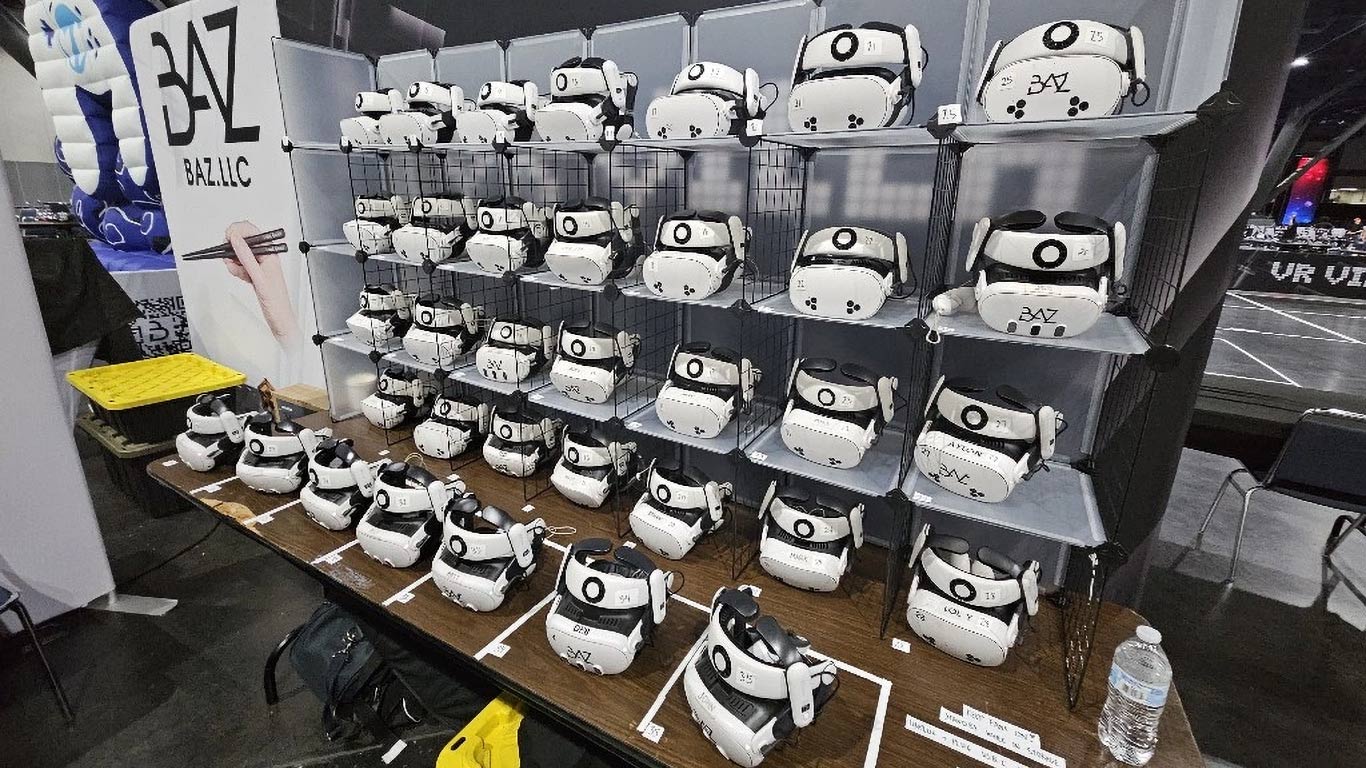
Jeff: I’m Jeff Basladynski. I’m the owner of Baz LLC. It’s a small woodcraft company specialized in exotic wooden chopsticks customized with your name, things like that. I’ve been a gamer for all of my life. I’ve been really enthralled with VR, specifically since 2016 when the Vive and Rift first came out. I got excited. I went out to these conventions for my business and then brought a couple of headsets. Then, it has spawned to the point where we have 100-plus headsets and go out and make a little fun VR LAN party almost every other weekend throughout the US from Hawaii to DC.

Tony: Nice. What is VR Villa? Because that’s the name of your, let’s say, “hobby”
Jeff: Yes, it’s more of like a community group per se, or almost like a computer club, but for VR specifically. Since I’ve been doing this for eight years, just organizing with the events that I’m already tethered with, a lot of the shows know who I am, what I do, and what I do for other shows. It just snowballed to that effect. I travel quite a bit and just really collaborate with about 68 studios now from Resolution, Schell, Mighty Coconut, everybody, just to really bring as much VR gaming potential out to these events and just have fun with good games, good content, because I think that there’s a lot of stuff in the VR world that people don’t realize.
People don’t really know what’s out there. Realistically, most conversations I’ve had with the public are: they just need a five-second help of saying what’s out there, and then you go saying, “Hey, this is the game that I play. You should probably play it. Then let me teach you how to play the game.” A lot of our time and effort is really just teaching one-on-one to the general public about what VR is, putting a headset on them, and hopefully allowing them to go play for a long time. It’s quite fun.
Tony: Sounds like a lot of fun. I want to get back a bit to your story. When I started following you on Reddit, in the beginning, I thought you were a VR entrepreneur. Then, I discovered, actually, your main job is making chopsticks, which is very fascinating. Can you tell me a bit more about how you went from making amazing chopsticks to making amazing VR demos? You’ve been doing that for a lot of years now.
Jeff: Yes, so I’ve been doing chopsticks for about two years longer than I’ve been doing VR gaming for events. It just slowly happened over time that when I went to the events to my retail sale for my booths and such, I would bring one headset once the exhibit closes. I’ll bring it to the game room and then play VR games with random people, one or two headsets. My friends and I, we got really into it.
We started this group. It was actually called VR Zone specifically earlier, then we just built a whole mantra. We call it a village because it’s a village of just hundreds of VR gamers throughout the US, just to bring the equipment and really staff it and provide it. After all, what we’re trying to do is like any hobby, like board games or video games or Warhammer. That’s a huge hobby.
You have a lot of these different groups coming out and doing the same thing. We’re doing the same style of effort, but with VR specifically. I’ve mastered the whole technique of logistics of how to get all this equipment out there, get the team out there, get staff, work with all the developers, hardware partners, to really try to build that conversation of what can we do and how can we represent the VR industry in this really unique, holistic way just so I can go play games, [laughs] and then share that with everybody else.
Tony: That’s great. You mentioned the logistics. Actually, as a very practical guy, I always read your posts and say, “How the hell does he organize all of this?” It seems like a huge effort. You need lots of people, lots of headsets. How do you handle this? How can people, maybe wanting to do the same thing, do the same kind of activations?
Jeff: The big thing really is because we’re already tethered to these events as an exhibitor, I piggyback on my main company of just providing the equipment out to these events. We just pack the van with equipment as much as we can probably bring, or whatever the budget could support, and how well we can do. Then I go to events and say, “Hey, I’m just looking for cost coverage.” This is the stuff that I have. These are the things that we have. This is the teams that we can really enable or really work with the different gaming communities, from VAIL to Blaston by Resolution, things like that, and really trying to bring everybody to the table of just saying, “What’s the most cost-effective way of getting the equipment to the events?”
When we flew to Hawaii, I brought 200 pounds of equipment, checked bags, no problem. It ended up being about 20, 22 headsets… we served about 500 people that weekend. Then, something like LVL UP EXPO, we would set up a whole pallet or two, put it on there with projectors, AV equipment, and just ship out 45, 50, 60 headsets, and really fill 5,000 square feet.

The conversations with conferences, gaming directors, the real thing is they turn me into the director of VR content for their shows, and then the conversation becomes, “What can we do? How can we really maximize gaming potential for games that I enjoy, that I like all these games?” I don’t put crap games. I don’t put games that I don’t find enjoyable. If some of my community members are more enthusiastic about a certain game, I’m like, “You know what? If you want to come and help, let’s make it happen, because you’re excited about that game. I’m not, maybe, but let’s see if that helps out.”
It’s really just trying to support the volunteers and staff that we have so that everyone’s excited. When you’re in a happy place and doing happy things and getting other people excited and becoming happy, it’s really infectious when you can really match that feeling of, “Oh, my God, this is a lot of fun.” Yes, it is. Now, come join us and be part of the VR Villa and go play some more games, find some friends, and see where we’re going to be next.
Some of these people who have found us at these events as players, just attendees at these events, end up becoming really good staff or volunteers for shows in their region, or maybe we bring the opportunity and be like, “You know what? Let’s fly you out to the show because we actually desperately need help for this game that you love and I love. Let’s have a good time.”
Tony: Amazing. Can you give us some statistics about what you’ve done? You’ve been to lots of events. You demoed VR games to thousands of people. Give us some stats.
Jeff: In the early days, we weren’t really as good at keeping track records of the statistics because we were just like, we bring one or two headsets, we’re fine, and see how well we do, whatever. Only in the last maybe four years, we’ve actually been really adamant about learning about the players, how well we serve them, and what games they’re playing and how long. We’ve really gotten really good at metric building and understanding.
Average times. I think last year, we did 25,000 people, almost 30,000 sessions. That’s been about roughly what we’ve been doing for the last three years. I know we passed 80,000 players in the last four years alone, at least recorded content, and then just really building that basis of how many people we can service. The big metric that I like to show is the average play time, which has been increasing significantly year over year.
I think in 2022, we had maybe 20, 22 minutes of play time average, mostly because we just didn’t have enough headsets. We actually artificially cut off play sessions after 30 minutes. People will come and play for five minutes or maybe up to 30 minutes. People will play long. If you let them play, they’ll play. Now we’ve been accumulating a big amount of equipment: at the end of last year, we had 200 headsets.
Unfortunately, there weren’t a lot of shows that really could give us the resources to be able to fill that level of operation, which we did at DreamHack. I think we had 100 headsets in 2024 from DreamHack Atlanta. We serviced 2,000-2,500 people at that one show at 10,000 square feet. We did that three times that year. Then, last year, we liquidated all of our Quest 2s. Now, all we have is 3s and 3S’s, which is still about 70, 75 headsets.
Now, it’s just, more or less, how well we can bring that equipment that we already have out to these events. The average has been about 30 headsets and about 3,000 square feet. To me, because I’m a community endeavor and I’m part of these events, we get a lot of these abilities that companies and corporations can’t. I don’t pay for being at these shows. They give us these abilities where we get host hotels. Sometimes we get food. We get money, then it helps with bringing professional staff that I’ve trained up over the last seven years of saying, “Hey, you’re really good. You’re worth this effort. Let’s get you paid because you’re doing 40 hours in three days,” and really trying to give back to the community and doing a good job. We’re doing a great job of being out there and getting all of these demos. I don’t like to say “demos.” I say “experiences” because I think last year, it was 32 minutes per play session.
One out of every five play sessions was a rebooking. That meant someone came in, played 30 minutes, loved it, said, “What else can we play?” and they booked another session right away and played another 30 minutes. Some people, especially when we have enough headsets, where we’re doing sit-down content like Demeo or Cook-Out, some of those players, those average gameplays can be an hour, 90 minutes.
I have recorded sessions where people play for four and a half hours for Demeo and play a full campaign. The joke has been, “Go play a short game of Demeo.” Everyone knows, at least in the community, that’s not a short game, but it’s a fun game. It’s really fun to be at this event where a lot of these players may not have these headsets, and they get this opportunity to go play. We keep this constantly.
“I bought a headset because we played this game and we learned this game. Now, we want to learn more about other very similar games or like games that I enjoy, that I played on flat screen or computer or mobile or anything.” It’s really building these one-on-one conversations on a scale that we’re doing it and enjoying it. Hopefully, what we’re doing is provide a benefit for the developers because it’s a struggle out there, the whole gaming industry. Not just VR, the entire gaming industry.
Tony: Wow. Big compliments because I think I made a lot of people try VR, but you are far beyond most of us with these numbers that are in the order of dozens of thousands. That’s super cool. By the way, you mentioned Demeo, but can you tell me some games that you made people try? And do you have a favorite or one that is special for you?
Jeff: The most played game today, and it has been the number one game for the last five years, has been Cook-Out, the four-player Cook-Out game from Resolution Games. I would say probably one in four sessions is nothing but Cook-Out. We build up this joke because all these shows are really dependent on the staff with knowledge about the games we support. Sometimes I may have a bunch of volunteers who may not know a lot of the games, so we curate that back a bit by saying, “We’re just doing simple games,” or not having internet on site, so we might not be able to support multiplayer games.
Everybody knows when we do these games that Resolution was one of our first partners. We’ve had Cook-Out at a lot of these events. It’s on all of my accounts, so everybody knows that. When we don’t have Cook-Out listed as one of the supported games for that specific show, everyone’s like, “We know you have Cook-Out. We want to play Cook-Out.” It’s like, “Okay, let’s figure it out. Let’s go play Cook-Out,” because it’s such a great game.
I think last year, we had 5,000 of the 23,000-25,000 play sessions being just Cook-Out. Right below that is Fruit Ninja, Space Pirate Trainer, Blaston, and then Walkabout Mini Golf. Those are our top five games that we’ve been statistically seeing as the most organically picked game. Really, those are pretty fun games. Fruit Ninja, Space Pirate, really short experiences. They’re great. Pick up and go for almost every new user.
We still average about 28%, 30% are their first time to VR with us year-over-year. Eight years doing this, and that number hasn’t dipped. That’s just some interesting statistics about that where we’re not servicing, really, VR veteran players. We’re still servicing the average general public who don’t know anything about VR, or they just lack the opportunity to go and even try, because a lot of the stuff you have out there is pay-to-play VR, like Sandbox or Zero Latency.

In terms of community-centric VR, free-to-play operations like what we do, there still aren’t that many others out there that do this other than the VR LAN guys out of Amsterdam. They’re the only people I know in the world that do something similar to what we do. It is a lot of work. It’s a lot of labor of love, and then really a lot of labor specifically to get people into headsets, teach them the system, the game, and then make sure that we give them the best chance to have fun.
I think that’s where the biggest drawback about how we operate is, because we’re not like a bowling alley. We’re not handing headsets to people. We’re teaching every single one how to use the operating system. We’re teaching them how to launch a game. We’re teaching them the game mechanics of that game and making sure, “Hey, I’m stuck in this place,” “Well, I play this game. This is the one trick you need to know how to get past this level or how to be better.”
Then, when you give that one-minute, two-minute, or three-minute little dialogue and make sure everyone’s good, they’ll play for hours. It’s amazing. We’ve even had a lot of people that were just like… they’ll play for 15 minutes and, like, “Am I done?” “No, we brought 100 headsets. You can go over there and play for the whole weekend if you want.” People have. It’s quite fun.
Tony: [laughs] It’s super fun. You saw thousands of people playing VR. There are people from all demographics… some veterans, some newcomers. I would really like to listen: What have you learned? What are the lessons learned by seeing so many people playing VR?
Jeff: Because of the way we operate as a community, we changed the conversation to the public. Not, “Should I try?” It’s, “What should I try?” That’s a huge cognitive disconnect when anybody else… like if Meta came and did what we did, everybody would know that they’re trying to sell something. For us, we’re just trying to have fun. That conversation straight up to the general public is, “I’m interested. I’m VR-curious. What is out there?”
In a lot of conversations we had, we noticed that people are not seeing ads about VR. The people who bought a headset are people who already have a headset. They already play the games they have, and then we hit that wall. Now, you’re getting to a point where everybody that we’re really servicing now doesn’t have a VR gamer friend, so they don’t have the access to try at home or wherever. They are not getting targeted advertisements about VR because they’re not interested, at least in an AdSense type of way.
Then, they’re just not accustomed to seeing it at a lot of retail operations or stuff because Meta pulled back a lot of these things, although they’re going back to Best Buy, I guess, apparently. It’s just a lot of conversations with what’s out there. Event at VR events, they don’t know 90% of the games that we have. You’ve got players who are saying, “Is there a Counter-Strike game?” It’s like, “Yes, there’s Contractors or VAIL.” “Is there a Battlefield game?” It’s like, “Yes, there’s Forefront.” “Is there some other team shooter?” “Yes, there’s Hyper Dash, there’s Breachers.” “What about a good role-playing game?” You’ve got Half-Life: Alyx if you’ve got a good PC. A lot of these are just really general conversations. People just want simple help. They just want to have simple questions answered genuinely without being targeted by a sales rep.
When they talk to us, it’s like, “What’s good?” “This is the stuff that I play. This is the stuff that I use.” We even get asked about the accessories that we use, when we update all of our headsets. That’s the second question right there: “I didn’t know I could play this long.” That’s what we get a lot of compliments from players about: “I thought this was going to be uncomfortable.” It’s like, “It can be if you just don’t buy the accessories to make it uncomfortable.” These are the ones that I’ve bought, that I’ve learned, that I play with.
If I play four hours straight of Forefront, this is something comfortable. This is the extra battery pack that I use that I can play without having to sit down. If I want to sit down, these are the games I play to sit down. It’s really just meeting people where they are, giving them the right information, and then doing it not in a sales-tactic way of like, “I’m here to make money. I’m trying to sell something to you.” It’s like, “No, we’re trying to teach you something that you are genuinely interested in.”
I think that’s what the industry is at an impasse. They can’t find those players, and we find them at all these events. I’m really privileged in the way that we operate that we have no issues getting players to come play because we’re free to play. They’re really genuine about learning what the technology and what games are out there. Hopefully, they enjoy it so much that we inspire them to go buy their headset, and we’ll play games and make them come back for the following show and be really good, or maybe become staff.

Tony: I really hope so. Since you mentioned the Best Buy demos that are now probably coming back… What’s your opinion on why they didn’t succeed the first time? They didn’t sell so many headsets…
Jeff: In my opinion, especially talking with Meta in the past and a couple of other retailers, I still don’t think it’s going to be a huge success the way that they’re going to operate. I’ve seen the layout plans from Best Buy: they’re doing a 30 x 30 area, 50 stores, 6 this year. Hopefully, they’ll roll out the rest, maybe at the end of the year, or starting next year.
They’re not getting enough play space availability to have those operations. Even when they did Quest 2 demos at Best Buy, Target, and a couple of other retailers, they didn’t have dedicated staff for that to really teach them this. Meta did a pretty good job with the glasses, getting those demos and doing demos, things like that. I have three Best Buy staff as part of my staff. Over the years, I hear what they’ve done at that store. It’s like some of these things are just like, they might do three or nine demos in a day.
And they’re not good demos. They’re just like, “Here, you got to hold the headset.” It should actually use the head strap. You’re just playing some of the demo stuff that Meta built for demos. You’re not playing a game. You’re in an aisle. I don’t think that it’s going to be as impactful in terms of getting the customers to understand what the technology can do, especially because they’re limiting those opportunities. Then, they’re really just going to be hammering the sales of the glasses, which is an amazing piece of technology. I think it does solve some problems or have interesting prospects for those clients, but they’re not going to hit the VR gamers. They’re not going to hit the VR consumers or VR-curious consumers because they’re not set up layout-wise. The reason why I go out to these events is that these events are where people are at. “Location, location, location”: that’s marketing 101. A lot of these shows that we go to are gaming-centric. Japanese shows, anime festivals.
DreamHack, one of the largest Esports companies in the world, where they fill 60,000 players playing all types and manner of games. They have 50,000 square feet just from Magic: The Gathering. You’ve got these really like-minded individuals, and a lot of these VR companies are not there. I’m at a lot of these shows. I’m still not seeing these VR companies going to their consumers to really try to promote their products, other than maybe PAX. Even PAX East and West, there weren’t a lot of VR companies there. I think a lot of the industry is changing away from that.
Tony: That’s interesting to hear. I would like to ask you: after these many demos, what are the things that your users are liking the most? Also, is there a type of people that like your demos the most? I don’t know, the kids, the elderly, the men, the women… do you have some stats like this?
Jeff: Yes, so we do capture demographic information about the public. We do play our games as part of our waiver process. About 30% is between 10 and 17 or 18. The next 26% is your young professionals, so 19 to 26, and then the rest is everybody else. While the industry is trying to promote this idea that it’s just all kids now, it’s really not. It’s just that the individuals who are our age, 26 to 35, they’re not getting service. They’re adventurous. They’re very curious.
That’s actually one of our largest demographics right now because a lot of these shows are really bringing these family-centric individuals. When we have these events, some of them where we get grandparents to go sit down and play Puzzling Places, while they wait for their adult kids to go play Cook-Out, while their grandkids or the children of the parents are going to play more active games like Blaston. I want to say maybe about 60%, 70% of our games are multiplayer games, and most of them are going to be collaborative. Collaborative games are very popular with the way that we operate.

Tony: What is it that, let’s say, people like the least? Maybe you had some problems or some type of people that say: “I hate VR.” [laughs]
Jeff: We don’t really get a lot of those people because, again, most of the people that we get are already curious about VR because they paid money to be at this event. We’re there as free-to-play. We get a lot of people walking by. They stop and say, “What is this about?” We just say, “Well, you can find out. We can throw you on a headset, and you can figure it out yourself, and we can help you support that and see what games.”
Usually, when we have this giant projector screen, 10 feet, with all the games listed. It’s answering the question: “Hey, what can I play?” We have a screen of 36 games that they can pick from, and we’re just saying, “What games do you like to play?” We’ll pare this down to one or two, and we’ll put you on. We usually just have a recommended, like the first maybe three games that we have on our list of what we expect new players to like, like Fruit Ninja or Space Pirate Trainer or Until You Fall.
Those are really one of the top games where we throw anybody in because they’re super fun, they’re easy to get, super easy to train. Easy for me to train staff to train others. It’s really just, what’s the lowest bar that I can get to go and make people have a good time? The games that are really hard to push are going to be the really long narrative RPG games. When we’re in a game room, it’s a very loud environment. Some of the RPG games are really hard to hear. Even when we use the KIWI head strap or the audio strap, which is really vital for the games like that, it’s just people like to have the more motion-active games. Especially when other people are running around and doing crazy stuff like with Spatial Ops, then they’ll see that and be like, “Oh, they look like they’re having fun.” Some of the more narrative-driven games are really hard.
Simulator games are really hard to do, unless you get sim fans at these events, like when we go to Sim Gaming Expo in Chicago. It’s really about matching the right content for the show, what I think the show would be successful at. The way I see it dictate my success is how well the systems that I brought, the amount of extra effort that I make sure these game rooms are really… I wouldn’t say profitable; I would say successful by being utilized.
To me, if I bring 50, 60 headsets to a show, I want all the headsets to be played and people having a good time. I don’t want 10 headsets out of the 50, 60 only being used and the rest of them just sitting. Then, that’s when we have a conversation of, “Okay, we’ve brought all this effort to do this to support the gaming community.” What happened, and what games were just not being organically picked, and we’re trying to pivot for the following year.
Maybe it’s just signage. Maybe it was foot traffic in our area. Maybe we just had bad optics to where we were positioned, or the show could have just been not a well-attended show. We have done that one or twice in the past, where we set up a large operation, and then people just didn’t come to the show. That’s sometimes the risk where we do all this effort, and we’re like, “Oh, where are all the gamers?” [laughter]
Tony: You did all these demos… and it seems that almost everyone likes playing your games, then why do you think VR is not succeeding now? Everyone is asking this question. Is it the price? Is it the form factor? What’s your take about this?
Jeff: I still think it’s just genuine marketing. Every single piece of equipment for the last four years for VR has been amazing. The Quest 2 is still an amazing piece of technology. When we had that little crossover between when the Quest 3 came out, we lagged about a year before we got our first Quest 3s. People thought when the Quest 3 came out, they thought the 2 was the 3. They’re like, “Wow, this is amazing.” It’s like, “No, it’s the same VR that we’ve had for the last four years. You’re just playing a different game.”
I think it’s just expectations and then having that access to get people to play the games. I love the Quest 3S. It’s a fantastic piece of hardware. The 3, I think it’s a great piece of hardware as well. People still think that the 3S is a terrible piece of VR, but it’s not. It’s really not. Not if you played OG VR back in the day with the Vive wands. Those were heavy controllers with a heavy head strap.
Really, it’s just getting through the consumer misconception of what the technology is, and how well it can be by making it really comfortable for everybody with the halo straps or the facial interfaces that are comfortable. Those are the two vital things that we changed right away. Grip straps that you have the Index-like straps on the controllers. I just think that a lot of people have a bad first-time impression based on not getting the guidance that they need when they first play.
I think that’s what the industry is really struggling with: getting that first-player experience and getting away from it. I think the people that we’ve had conversations with who’ve only played Google Cardboard, and they’ve never tried VR again, and we ask them why, it’s like, “Because I thought everything, for the last eight years, has been nothing but Google Cardboard.” It’s like, “Well, that’s a free thing that you use your cell phone.” Honestly, it was a terrible experience 10 years ago. This is a little bit different.
I think access to try is the biggest component. We did this survey about a year ago, a year and a half ago, with about three major shows. It’s like a 3,600-person survey. We actually asked people certain questions and let them play, and then had the survey again after they played immediately at that show to correlate on what they thought, what they think the VR is, and then we asked them if they were willing to buy a headset before and after. Then, we saw that we did something amazing. On 57% of people, we changed their perspective positively, and they were willing to go buy a headset right after a 20-minute game session. Then, what was interesting to me when we did the data: people who were still, “No, I don’t want to buy a headset,” they go play. Everybody has a great time. They were still, “No, I don’t want to buy a headset,” but then I asked the question right after. Would you have bought a headset from me when you just played Cook-Out with your three friends? They said, “Yes.” 17% said, “Yes, I would have bought a headset right there and there, $500 with a cool package, with a game that I played, I enjoyed with my friends.” That social dynamic of that social pressure: I just played a really fun game with my friends for 45 minutes. I’m really susceptible to buying it now because it’s here, and we’re going to go buy it. We’re going to go back to the hotel. It’s Friday night. We’re going to play a VR game in our hotel room. We’re having a great time. We’re going to come back the next day.
I think that’s the conversation that the industry just isn’t really having of turning those consumers who are already curious into actual buyers, and then trying to say, “If you like that game, here’s a list of all the other games that you’re going to enjoy.” I really think it’s just game discovery, access to try, and then getting through all the marketing spiel, all the crap that the industry is just like, “Oh, it’s better with this piece of chip, or that piece of chip. Look at the graphics.” It’s not about graphics. It’s about how well the game plays and how well the game plays with your friends. I think that’s the biggest motif that we keep experiencing for the last eight years. We continue to experience that even this year. What makes good games good? It’s not graphics. It’s having fun with friends and making sure you’re not getting clustered or getting artificial barriers. Sometimes the industry puts more barriers than it removes.

Tony: Well, I think you should probably sell the headsets after the demos. You’d probably become rich…
Jeff: We tried. We’ve actually asked Meta for the last five years about doing retail operations to sell these headsets. I work intimately with BOBOVR and KIWI Design, so we have their head straps. They would absolutely love to have the opportunity for us to sell their accessories, but I can’t sell accessories when 72% of our players don’t own a headset. Then, still one in three, it’s their first time in VR. We get asked every weekend, why don’t we sell headsets? It’s like, “Well, that’s a very good question.” [laughs] I sell chopsticks. That’s about it.
Tony: If, after this interview, some people got curious about your work and would either want to collaborate with you or they want to try your installations: how they can find you, help you, visit you, everything?
Jeff: Yes, so they can go to our website at vrvilla.org. We try to keep the website updated as much as possible in terms of the events that we are 100% confirmed and supporting. Hopefully, if they want to reach out, they can join our Discord and follow up with our staff, and see if they want to help or see ways we can communicate. Yes, there are a lot of conversations we’re really building up. We’re having a lot of opportunities that we have that sometimes our community can’t see. We’re here to have fun and play games, support the developers, and really hopefully get the next generation… or whichever generation is really excited, from kids to grandparents.
Tony: Fantastic. Is there any advice you want to give to the VR community in this moment of, let’s say, winter?
Jeff: Well, my advice is go play games, get others to go play games, and then have a good time, and then really just try to share your passion like how we were doing it with others. I think that the more people like what I’m doing out there in the world, it doesn’t have to be crazy big. You don’t have to bring 1,000 headsets. You can just bring one headset. Bring a couple of controllers, bring a gamepad, and go play DAVIGO or Acron, or just play games. A lot of these games are social experiences, and you want to go play games with your friends.
Tony: Fantastic. I would like to speak with you for a long time because I love your passion, but time is up. Just the usual last question, which is, is there anything else you want to add or you want to say to people listening to this interview?
Jeff: The only thing I would say is I really wish the VR industry was more built upon sustainability pathways than anything, because I think that’s one of the biggest misconceptions is that VR is not successful because it’s not everywhere. We’ve been sold this bill of goods from the industry that it’s going to hit a billion users within 10 years. Unfortunately, that’s not going to happen.
I think there are a lot of limitations with technology, even with a good form factor it is today. I think if everybody really focused on sustainability in terms of making sure that whatever the building can hit, they find their target demographics, and sell it directly to those individuals who are curious, I think that would be a better, well-off position for the industry, and then instead of trying to say, “Hey, we’re going to do everything that Gorilla Tag does.” Well, it only works for Gorilla Tag. “Hey, we’re going to do this really successful thing for that.” Again, the market is not there. At the same time, when you look at the statistics, there are more VR players today than ever before. I think Meta pulled out, what, 11, 12 million active users on their platform specifically. That’s a lot of players. But in their eyes, it’s not. I think the industry needs to take it as is and do the best they can with the market that is right now.
Tony: Great. Really, thanks a lot for joining the interview. Thanks again for what you’re doing for the world community. Thanks a lot. Thanks also to everyone reading this interview. I wish you a great day in VR. And if you can join Jeff in one of his activations around the US and maybe hopefully the world, please do it. Have a good day, everyone. Bye-bye.
Jeff: Bye.
(Header image by Jeff Basladynski)
Disclaimer: this blog contains advertisement and affiliate links to sustain itself. If you click on an affiliate link, I'll be very happy because I'll earn a small commission on your purchase. You can find my boring full disclosure here.